SD-Branch: Converging Network and Security at the Branch

The branch closet is where architecture goes to sprawl
Walk into the network closet of a typical retail store, clinic, or regional office and you will usually find a stack of single-purpose boxes: a router from one vendor, an edge firewall from another, an unmanaged or lightly managed switch, and a couple of access points on a controller that may or may not still be supported. Each device has its own console, its own firmware cycle, its own support contract, and its own way of failing. Multiply that by fifty, two hundred, or a thousand sites and the branch edge becomes the least consistent, least visible, and most truck-roll-hungry part of the entire estate.
SD-Branch is the response to that sprawl. It takes the functions that historically shipped as separate appliances — WAN routing, LAN switching, wireless, and security — and delivers them as one managed platform, provisioned and operated centrally. The goal is not just fewer boxes. It is a branch that behaves like a single, template-driven unit you can stand up, change, and audit from the cloud, instead of a bespoke snowflake that needs a specialist and a site visit for every adjustment.
What SD-Branch actually consolidates
The term gets used loosely, so it helps to be specific about the functions that fold into a single managed fabric:
- SD-WAN. Application-aware routing across whatever transport a site has — fiber, business broadband, LTE or 5G — with path selection, brownout detection, and sub-second failover. This is the transport intelligence, and our managed SD-WAN practice is typically the anchor of an SD-Branch design.
- Routing and WAN edge. The traditional branch router collapses into the same platform, so there is no separate device to license, patch, and troubleshoot.
- LAN switching. Access-layer switches come under the same controller, which means VLANs, port profiles, and PoE for phones and cameras are pushed as policy rather than configured port by port on site.
- Wireless. Access points join the same management plane, so SSIDs, segmentation, and RF settings are consistent across every location instead of drifting per store.
- Security. A stateful firewall, intrusion prevention, URL filtering, and segmentation run at the edge so branches can break out to the internet directly without hairpinning every packet back to a data center for inspection.
The value is the convergence, not the feature list. When routing, switching, wireless, and security share one policy model and one telemetry stream, a change is expressed once and applied everywhere it applies. Segmentation you define for the guest WiFi automatically carries into the firewall rules and the switch port profiles, because it is one policy, not four that have to be kept in sync by hand.
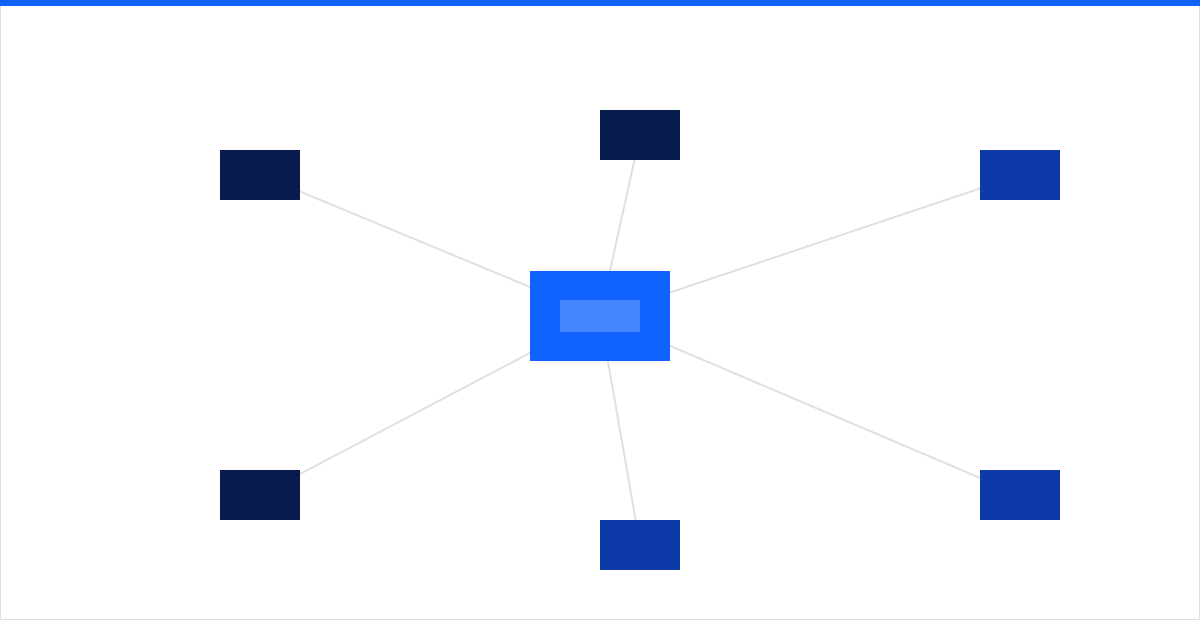 Figure: SD-Branch pulls the branch stack under one central controller, so each site is a spoke driven by the same policy rather than a separately configured island.
Zero-touch provisioning: standing up sites without a truck roll
The most immediately felt benefit is how a new site comes online. With zero-touch provisioning (ZTP), the hardware is never hand-configured. The sequence looks like this:
- Pre-stage the design centrally. You build the site's configuration as a template — WAN links, VLANs, SSIDs, firewall policy, QoS — before any hardware ships.
- Ship the appliance to the site. It arrives in the box, unconfigured, and is racked or plugged in by whoever is already there: a store manager, an electrician, a general contractor. No network engineer required on premises.
- The device phones home. On power-up and internet reachability, the appliance authenticates to the cloud controller using its serial number or a certificate, and pulls its assigned configuration.
- Policy lands and the site converges. Switching, wireless, and security profiles apply automatically. The branch is production-ready in minutes, and the same template guarantees it matches every other site of its type.
The operational difference is large. A traditional branch turn-up often means scheduling a field engineer, shipping pre-configured gear, and eating the delay and cost of a site visit — the network becomes the long pole in every store opening or acquisition integration. ZTP turns that into a shipping-and-shelving task, which is what makes SD-Branch viable at the scale of hundreds or thousands of locations.
Centralized policy and visibility
Once sites are converged, the day-two story is where SD-Branch earns its keep.
- One policy plane. Configuration is expressed as templates and profiles, not device-by-device CLI. A change to a firewall rule or a VLAN is authored once and pushed to every site in the relevant group, which kills the configuration drift that makes branch fleets so hard to audit.
- Fleet-wide visibility. A single console shows link health, application performance, client experience on the WiFi, and security events across every location. Instead of logging into individual boxes to chase a problem, you see the whole estate and can spot the one site behaving differently.
- Consistent segmentation. Point-of-sale, corporate, IoT, and guest traffic are separated by policy that follows the same model everywhere, so a camera or a kiosk at one branch cannot become the soft entry point that a flat network invites.
- Faster mean time to resolution. When routing, switching, wireless, and security telemetry live in one place, correlating a user complaint to a degraded circuit or a saturated access point takes minutes rather than a cross-vendor scavenger hunt.
For organizations that operate across regions, this branch layer should tie into a resilient global network backbone, because consistent branch policy is only half the picture — the inter-region and data-center paths are where jitter and loss quietly accumulate.
The economics: fewer truck rolls, less appliance sprawl
The business case for SD-Branch is rarely a single line item. It is the sum of several recurring costs that consolidation compresses:
- Fewer truck rolls. Site turn-ups, hardware swaps, and many changes stop requiring a field visit. For a large fleet, avoided dispatches are often the largest single saving, because each visit carries labor, travel, and scheduling delay.
- Less appliance sprawl. Collapsing four device categories into one managed platform reduces hardware count, support contracts, firmware cycles, and the spares inventory you carry for each site.
- Lower operational load. One console and one policy model mean a smaller, more consistent runbook, and less specialist time spent reconciling vendor-specific configurations.
- Faster expansion. When a new location can be live in a day instead of weeks, the network stops being the constraint on opening stores or absorbing an acquisition.
Treat any percentage claims directionally and model them against your own dispatch rates and refresh cycles — the point is that the savings are structural and recurring, not a one-time hardware discount.
Where SD-Branch fits versus SASE
SD-Branch and SASE are complementary, not competing, and the distinction is worth getting right before you scope a project.
- SD-Branch is about the physical site. It consolidates the on-premises stack — routing, switching, wireless, and edge security — into one managed platform. Its center of gravity is the branch closet.
- SASE is about cloud-delivered security following the user. It converges SD-WAN with cloud security services — secure web gateway, cloud access security, zero-trust network access, and firewall-as-a-service — enforced at provider points of presence close to wherever people and workloads are.
They meet at the edge. SD-Branch gives each location a clean, uniform on-ramp and enforces local segmentation and inspection; a SASE architecture extends consistent policy to remote and mobile users who are not behind any branch appliance at all. Many organizations run both: SD-Branch standardizes the fixed sites, while SASE covers the roaming workforce and cloud-bound traffic. Choosing one does not retire the need for the other — together they let policy follow both the site and the user.
Making the move
SD-Branch is worth serious evaluation if you operate many similar locations, your branch turn-ups are slow and dispatch-heavy, or your closet inventory has quietly grown into a multi-vendor patchwork nobody wants to touch. The right starting point is an inventory of your sites, transport, and the device categories you are paying to manage separately — that is what reveals how much sprawl consolidation can actually remove.
intSignal designs, provisions, and operates SD-Branch and SASE networks for organizations nationwide, from zero-touch rollout across a large fleet to the central policy and monitoring that keeps every site consistent afterward. If your branch edge has become the least visible and most truck-roll-hungry part of your network, talk to our network team to map your sites and traffic to a converged design.