Multi-Site WAN Design for Distributed Businesses

A distributed business is a network problem before it is anything else
Every location you add — a branch, a warehouse, a clinic, a pop-up retail site — is another set of users who expect the same application performance as the headquarters staff sitting next to the data center. The wide-area network is what makes that promise credible or breaks it. Get the topology, transport, and steering right and new sites come online in days on a repeatable template. Get them wrong and every location becomes a bespoke project, a support ticket generator, and a security gap.
The goal of a modern WAN design is not the most elegant network. It is the most reproducible one: a small number of site archetypes, a consistent transport strategy, policy-driven routing, and security enforced identically everywhere. This post walks the decisions that get you there.
Topology: hub-and-spoke, mesh, or regional hubs
Topology defines how sites reach each other and the resources they share. Three patterns cover almost every distributed business, and most mature networks end up blending them.
- Hub-and-spoke. Every branch connects back to one or two central hubs — a data center or a cloud region. Simple to operate, easy to secure at the center, and cheap to add spokes. The cost is latency and a single chokepoint: branch-to-branch traffic makes two trips through the hub, and any real-time flow between spokes pays for the horseshoe.
- Full or partial mesh. Sites build direct tunnels to one another. Latency drops and no single hub bottlenecks the network, which matters for voice, video, and site-to-site applications. The tradeoff is complexity: a full mesh of N sites needs on the order of N-squared tunnels, so a 40-site full mesh means managing hundreds of adjacencies. Partial mesh — direct paths only between sites that actually talk — is the practical middle ground.
- Regional hubs. For businesses spanning geographies, a hub in each major region aggregates local spokes and interconnects with the other regional hubs. Traffic stays local when it can and crosses the backbone only when it must. This is how most multi-national distributed networks are actually built.
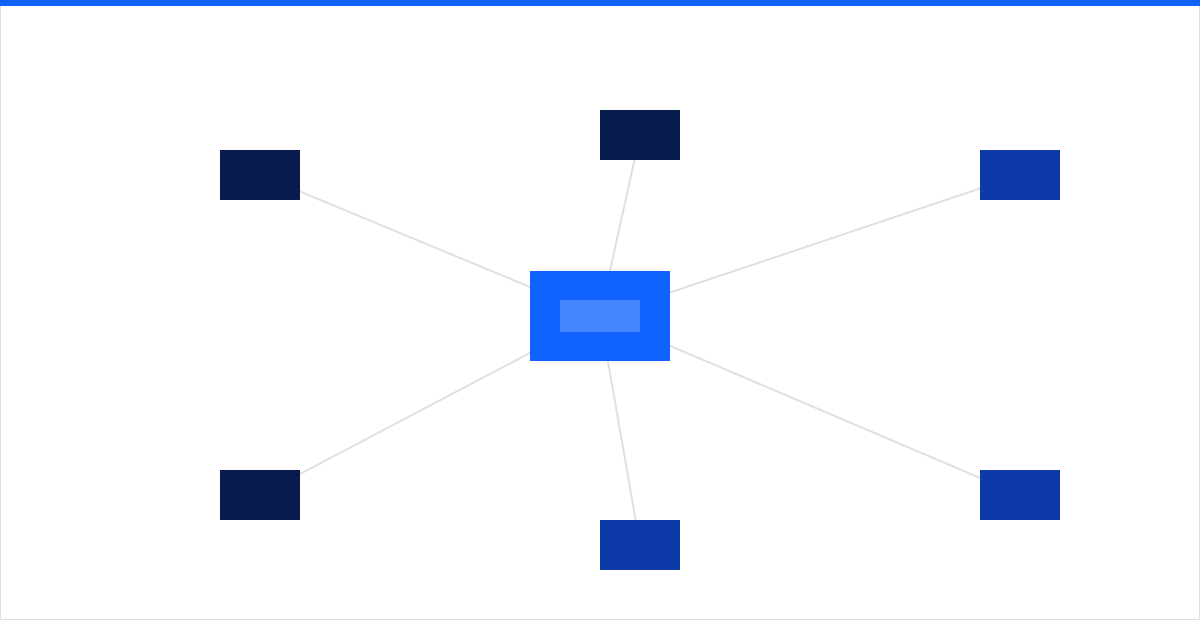 Figure: a hub concentrates policy and inspection, but every spoke-to-spoke flow pays for the round trip — which is why real-time traffic often needs a direct path.
The right answer depends on traffic shape, not headcount. Map who talks to whom before drawing the topology: if 90 percent of branch traffic is destined for SaaS and cloud, a clean hub-and-spoke with local internet breakout beats an over-built mesh. If sites run chatty east-west applications, add partial-mesh paths where the flows justify them.
Transport mix: fiber, broadband, and LTE under one fabric
The era of buying a single expensive private circuit per site is over. Modern WAN design blends transports and lets software decide which one carries what.
- Fiber / dedicated internet access. The primary link where available: symmetric, low-jitter, with a real service-level agreement. Worth the premium for sites running real-time media or hosting local services.
- Business broadband (cable/DSL). Excellent cost-per-megabit for a secondary link or the primary at low-demand sites. Asymmetric and best-effort, so pair it, never lean on it alone for critical flows.
- LTE / 5G. No longer just failover. Fixed wireless can be a viable primary at hard-to-cable locations and a genuine active path for a subset of traffic. It is also the fastest way to stand up a temporary or pop-up site the same day.
SD-WAN is what turns this grab-bag of links into one logical, resilient transport. Instead of an active/standby pair where the backup sits idle, an SD-WAN edge runs multiple links active at once, measures loss, latency, and jitter on each in real time, and places every application on the link that meets its requirements. When a fiber link degrades — brownout, not a clean failure — it can shift a live voice call to broadband or LTE fast enough that users never drop. The budget outcome is meaningful: two commodity internet links plus SD-WAN frequently deliver better real-world availability than one costly private circuit, at a fraction of the recurring cost.
Routing and traffic steering
With multiple paths available, the intelligence lives in how you steer traffic across them. Design policy around application intent, not raw destination IPs.
- Define application classes. Group traffic into a handful of intent-based classes: real-time (voice/video), business-critical SaaS, bulk/background (backup, patching, sync), and general internet. Everything downstream keys off these classes.
- Set path SLAs per class. Real-time media might require loss under one percent and latency under 150 milliseconds; bulk transfer cares only about throughput. Encode those thresholds so the fabric can enforce them.
- Steer dynamically. The edge continuously scores each link and routes each class to a path that meets its SLA, with defined failover order when none does.
- Protect the fragile from the greedy. Rate-limit bulk flows and give real-time traffic a priority queue so a nightly backup can never crowd out a live call.
Keep the underlying routing predictable. Summarize address space by region so routing tables stay small, use consistent metrics, and design failover so a link or hub loss reconverges in seconds with no manual intervention. The fanciest steering policy is worthless if the base routing does not converge cleanly under failure.
Direct cloud on-ramp versus backhaul
This is the single highest-leverage decision in a distributed WAN, because for most businesses the majority of traffic now goes to SaaS and public cloud, not the data center.
- Backhaul. Send branch traffic to a central hub, inspect it, then out to the cloud and back. It preserves centralized security but forces cloud-bound traffic through a long, congested horseshoe and makes the hub a bottleneck the day everyone is at a branch.
- Direct/local breakout. The branch sends SaaS and cloud traffic straight out its local internet link, keeping only genuine data-center traffic on the private path. Shorter path, lower latency, no hub choke.
- Cloud on-ramp. Peer the SD-WAN fabric directly into the cloud provider's network — through a colocation exchange or the provider's own edge — so branch traffic reaches the workload over an optimized path instead of the open internet.
For SaaS-heavy organizations, local breakout paired with a cloud on-ramp wins on performance almost every time. The old objection — that breakout meant losing central inspection — is answered by moving security to the edge and the cloud, which is the next decision. When those sites span countries, the same steering and performance guarantees have to hold across global networks, not just within one region.
Security at every site
A distributed WAN multiplies your attack surface by the number of sites. Security cannot be a headquarters-only feature that branches inherit by accident.
- Enforce identically everywhere. Firewalling, intrusion prevention, DNS filtering, and TLS inspection should apply the same way at a three-person branch as at the data center. Local breakout without local (or cloud-delivered) inspection is an open door.
- Converge networking and security. A Secure Access Service Edge model delivers firewall, secure web gateway, and zero-trust access as a cloud service the branch connects into, so breakout traffic is inspected without backhauling it. This is the cleanest way to keep the performance of local breakout and the assurance of central policy.
- Segment east-west. Guests, IoT/OT devices, point-of-sale, and corporate users belong in separate zones so a compromised camera at one site cannot reach finance systems at another. Segmentation is what contains an incident to one blast radius.
- Assume the private WAN is not trusted. Encrypt every site-to-site tunnel and authenticate the edges. A leased line is not inherently safe.
Standardizing site templates for scale
The difference between a WAN you can grow and one that owns you is standardization. Define a small catalog of site archetypes and deploy from it.
- Build two or three archetypes — small (single link, LTE backup), medium (dual internet, SD-WAN), large (fiber plus broadband plus regional-hub uplink) — and resist one-off designs.
- Template the full stack per archetype: transport, edge hardware, routing policy, QoS classes, security profile, and address plan, all versioned as configuration.
- Zero-touch provisioning. Ship the edge device to the site, have someone plug it in, and let it pull its config and policy automatically. New sites come up in hours on a known-good baseline instead of days of manual work.
- Monitor from one pane. Continuous infrastructure monitoring across every site turns slow degradation — a link quietly running at 95 percent every afternoon — into an early signal instead of a helpdesk surge.
Standardization is also what makes compliance auditable: when every site is a version of a template, proving controls are consistent is a configuration review, not a site-by-site expedition.
Build a WAN that scales with the business
A multi-site WAN succeeds when adding the next location is boring — a template, a shipped appliance, and a config pull, not a project. That takes deliberate choices: a topology matched to real traffic, a blended transport mix under one SD-WAN fabric, intent-based steering, local breakout with cloud on-ramps, security enforced identically everywhere, and a small catalog of repeatable site templates. intSignal designs, deploys, and monitors distributed networks built to grow without growing their complexity. Talk to our network team to map your sites, right-size your transports, and turn your WAN into a template instead of a to-do list.