Data Pipelines for Machine Learning: The Unsung Foundation

The model is the easy part
Ask a data science team where their time actually goes and the answer is rarely "tuning the model." It goes into the plumbing: pulling data out of source systems, reconciling schemas, computing features, backfilling history, and chasing down why last night's job produced numbers that do not match this morning's. A model is a few hundred lines a competent engineer can stand up in an afternoon. The pipeline that feeds it reliably, on schedule, with validated, reproducible data is what takes months and decides whether the effort ships.
This is the difference between a machine learning demo and a machine learning product. A demo runs once, on a static CSV, on someone's laptop. A product runs every hour, on live data, computing the same features the same way in training and production, and it keeps running when an upstream team renames a column without telling anyone. The gap between the two is entirely engineering — the pipeline that turns raw data into features a model can trust. That is where most initiatives quietly die, and it is what this post is about.
The anatomy of an ML pipeline
Strip away the vendor logos and every production ML pipeline moves data through the same stages, each of which fails in its own way.
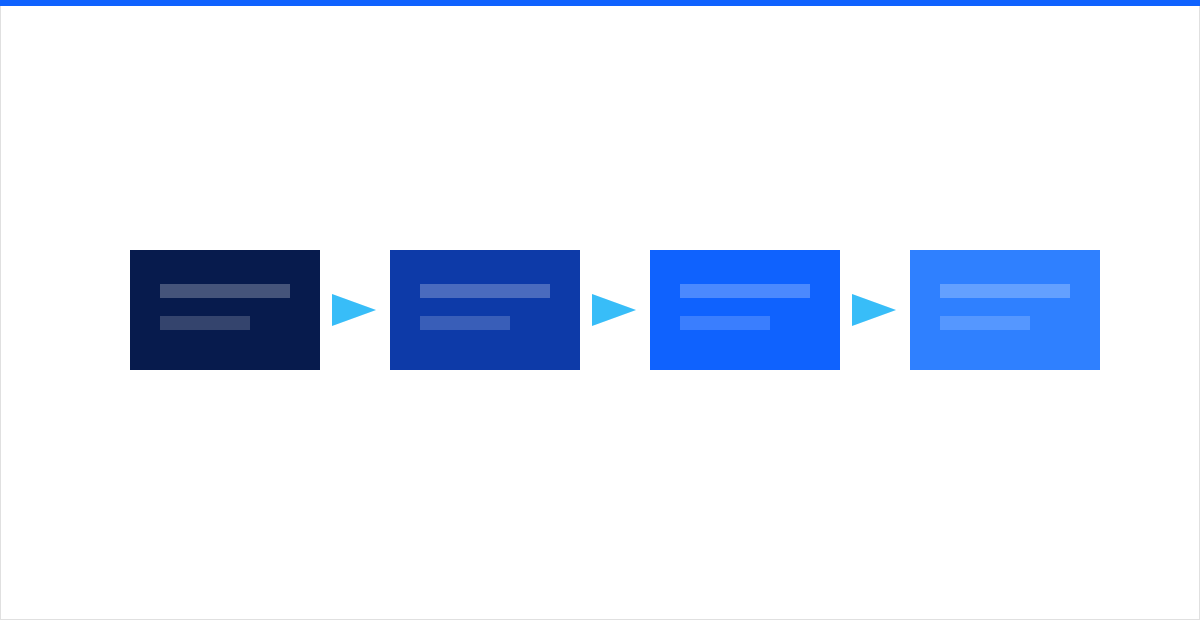 Figure: a model consumes the output of a long chain of stages; a silent failure at any one of them poisons everything downstream.
- Ingestion. Data is pulled from source systems — databases, event streams, APIs, files — into a place you control. The hard problems are schema drift, late-arriving data, and duplicates from retried deliveries.
- Transformation. Raw records are cleaned, joined, deduplicated, and standardized. Errors here propagate invisibly: a bad join silently inflates row counts, and the model learns from the inflation.
- Feature engineering. Cleaned data becomes model inputs — aggregations, encodings, time-window statistics, derived signals. This is where domain knowledge lives and where the most damaging bugs hide, because a feature can be subtly wrong and still look plausible.
- Serving. Features reach the model, in batch (scoring a table overnight) or online (answering a request in milliseconds). The serving path must produce the exact same feature values the training path did — more on that below.
The discipline is treating this chain as one versioned, tested system — with owners, tests, and monitoring at each stage — rather than a pile of scripts that happen to run in sequence.
Batch versus streaming: pick per use case, not per fashion
The first architectural fork is data freshness, and teams often over-engineer it.
- Batch processes data on a schedule — hourly, nightly, weekly. It is simpler to build, cheaper to run, trivial to backfill, and correct for the majority of ML use cases: churn scoring, demand forecasting, risk models, predictive maintenance. If a prediction that is an hour old is still useful, batch is the right answer.
- Streaming processes events as they arrive, keeping features fresh to the second. It is the right answer only when staleness genuinely breaks the use case — fraud detection, real-time recommendations, dynamic pricing, anomaly detection on live telemetry. It also costs more to operate and is far harder to debug.
Many mature architectures run both: streaming keeps a small set of latency-critical features fresh while batch handles the heavy historical aggregations. The mistake to avoid is defaulting to streaming because it sounds modern. Latency is a requirement to be justified, not a badge. Both patterns lean on elastic compute and storage, which is why pipeline design and your cloud infrastructure strategy have to be decided together rather than in sequence.
Training-serving skew and the case for a feature store
Here is the failure that humbles teams shipping their first model. In training, you compute a feature — say, "average transaction value over the last 30 days" — with a clean SQL query over historical data. In production, a different engineer reimplements that feature in application code to serve it in real time, and the two implementations disagree in some edge case: one counts a partial day, the other rounds differently, one includes refunds. The model was trained on one definition and served another. Accuracy quietly craters, and because nothing errors out, the bug can live for months.
This is training-serving skew, one of the most common reasons a model that tested well underperforms in production. The structural fix is a feature store: a central system that computes and stores features once, then serves the identical values to both training and serving. It gives you:
- One definition per feature, computed once, so training and production cannot drift apart.
- Point-in-time correctness for training — assembling feature values as they existed at each historical moment, so the model never trains on information from the future, a leakage bug that makes a model look brilliant in testing and useless in reality.
- Reuse across models, so the "customer tenure" feature three teams need is built and validated once instead of three subtly different ways.
You do not need a feature store on day one. You need it the moment a second model ships or a feature has to be served online — that is when skew and duplication start costing you.
Validate data inside the pipeline, not after the outage
A model cannot raise an exception when its inputs quietly go wrong — it just produces worse predictions, and you find out from a business metric weeks later. The defense is treating data like code and testing it at every stage. Checks to enforce as pipeline gates:
- Schema validation. Column names, types, and nullability match the contract. An upstream rename fails the job loudly instead of silently producing nulls.
- Range and distribution checks. Values fall within expected bounds, and each feature's distribution has not shifted suddenly from yesterday's — an early signal of an upstream break or genuine data drift.
- Volume and freshness checks. Row counts sit within a sane band and the data is actually new. A feed that stopped updating on a holiday is caught before it reaches the model.
- Null and uniqueness thresholds. A key that should be unique still is; a field that is normally 2 percent null did not jump to 40 percent overnight.
The rule that separates mature teams: a pipeline should fail closed. If input data violates its contract, the run halts and alerts rather than serving a fresh batch of quietly corrupt predictions. Serving no prediction is recoverable; serving thousands of confident wrong ones erodes trust in the whole program. These practices are the operational core of the data analytics work that has to exist before a model can be trusted.
Lineage and reproducibility
When a model's predictions go wrong — and eventually one will, in front of a regulator, an auditor, or an executive — you need to answer a specific question: exactly what data, code, and parameters produced this result? If you cannot, you cannot debug it, defend it, or reproduce it. Reproducibility is the difference between fixing a bad model in an afternoon and starting over.
Three things have to be versioned together:
- Data. A snapshot or immutable reference to the exact training set, so you can rebuild it. "The customers table as of last March" is not a version.
- Code. The transformation and feature logic, in source control, tagged to the model that used it.
- Model and parameters. The trained artifact plus the hyperparameters and pipeline run that produced it, tied back to the data and code above.
Lineage ties the chain end to end: this prediction came from this model, trained on this data, transformed by this code, sourced from these systems. Beyond debugging, lineage is what lets you assess the blast radius when an upstream source is found to be wrong — you can see every model and dashboard that consumed it — and it is increasingly what auditors expect.
Orchestration ties it together
All of these stages have to run in the right order, on schedule, with retries when a step fails and alerts when it cannot recover. That is the job of an orchestrator — the control layer that runs the pipeline as a dependency graph, so feature engineering waits for transformation, transformation waits for validated ingestion, and a failure partway through does not leave you with half-updated features. Good orchestration gives you scheduling, retries with backoff, dependency management, backfills, and one place to see what ran, what it produced, and what broke. Without it, "the pipeline" is a fragile chain of cron jobs that only one engineer understands and no one can safely change.
Build the pipeline first
The pattern behind ML programs that ship is consistent: they invest in the pipeline before they fall in love with the model. Reliable ingestion, features computed once and served consistently, validation that fails closed, lineage you can audit, and orchestration you can operate — that foundation is what lets a model deliver value for years instead of decaying in production after a strong demo.
This is the engineering intSignal builds for clients running machine learning and AI in production: the data plumbing that makes the model the easy part. If your team spends more time firefighting broken feeds than improving models, talk to us and we will engineer the pipeline first.