Retrieval-Augmented Generation (RAG), Explained for the Enterprise

Why ground a model in your own data
A general-purpose large language model knows a great deal about the world and almost nothing about your business. Ask it about your refund policy, your network architecture, or last quarter's contract terms and it will do what these models do when they lack facts: produce a fluent, confident answer that may be wrong. For a casual query that is a nuisance. For a customer response, a compliance answer, or an engineering decision, it is a liability.
Retrieval-augmented generation (RAG) closes that gap. Instead of hoping the model memorized the right fact during training, RAG retrieves the relevant passages from your own documents at query time, hands them to the model as context, and asks it to answer using that material and cite it. The model reasons over text you supplied rather than inventing from parametric memory.
Two properties make this the default architecture for enterprise AI:
- It cuts hallucination. When the model is instructed to answer only from retrieved passages and to cite them, unsupported claims drop sharply and become checkable. A reader can click through to the source instead of trusting a paragraph on faith.
- It keeps data private and current. Your knowledge stays in a store you control, not baked into a shared model's weights. Update a document and the next answer reflects it — no retraining, no frozen snapshot.
How a RAG pipeline actually works
RAG is not one component; it is a pipeline, and every stage is a place where answer quality is won or lost.
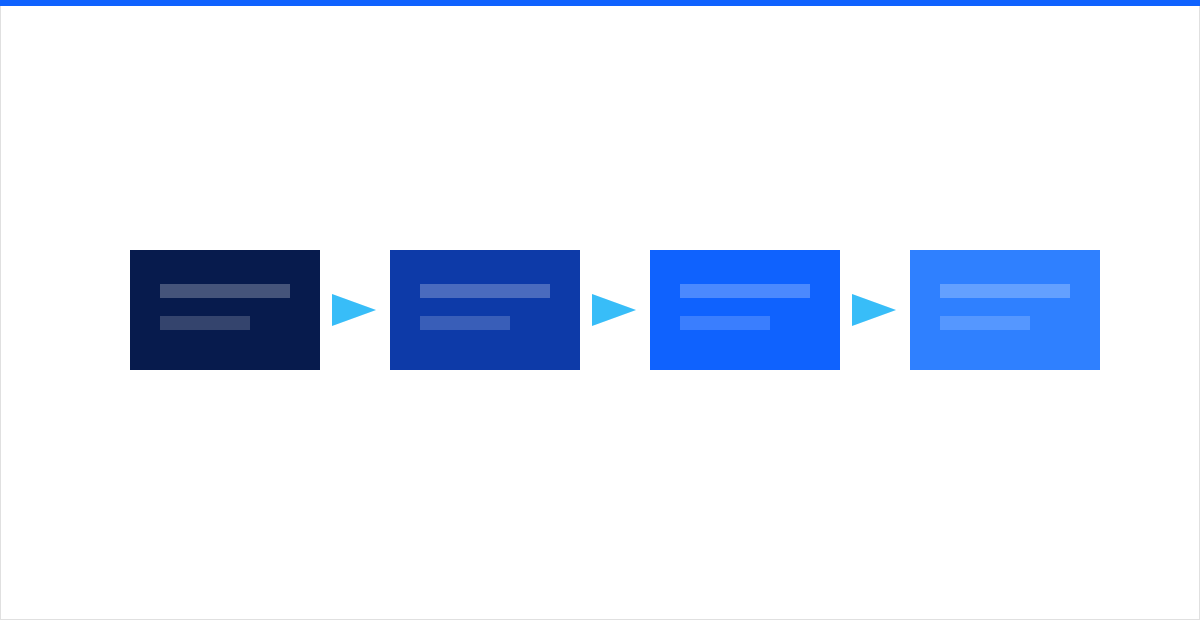 Figure: each stage is a control point — weak chunking or retrieval upstream caps answer quality no matter how capable the model downstream.
- Ingestion and chunking. Documents — PDFs, wiki pages, tickets, contracts — are split into passages small enough to retrieve precisely but large enough to carry meaning. A common starting point is 200 to 500 tokens per chunk with a modest overlap so a sentence split across a boundary is not lost. Chunk on structure (headings, sections) rather than blindly on character count, and keep metadata with each chunk: source, title, section, permissions, and last-modified date.
- Embedding. Each chunk is passed through an embedding model that turns text into a vector — a list of numbers, often several hundred to a couple thousand dimensions — positioned so semantically similar text sits near it. The same model later embeds the user's query so both live in the same space.
- Vector store and index. The chunk vectors go into a vector database or search index built for fast approximate nearest-neighbor lookup. At query time it finds the chunks whose vectors are closest to the query vector, typically by cosine similarity, and returns the top matches.
- Retrieval. The query is embedded and the store returns the top handful of candidate passages. Strong systems do more than pure vector search: hybrid retrieval combines dense (semantic) search with keyword search so exact terms — a product SKU, an error code, a policy number — are not lost, and a reranker reorders candidates for relevance before they reach the model.
- Generation with citations. The retrieved passages are inserted into the prompt alongside the question, with an instruction to answer only from the supplied context and to cite the source of each claim. The model composes the answer; the citations let a human verify it.
RAG or fine-tuning: pick for the job
Teams routinely reach for fine-tuning because it sounds more advanced. For teaching a model facts, it is usually the wrong tool.
- RAG injects knowledge at query time from a store you control. Access rules survive, facts stay current, and answers can cite their sources.
- Fine-tuning bakes patterns into the model's weights through additional training. It changes how the model behaves, not what it can look up.
Use RAG when the goal is to answer from a corpus that changes — policies, knowledge bases, tickets, documentation. Use fine-tuning for style, tone, and format, or to lock in a consistent output structure a prompt cannot reliably produce. The two are complementary: when in doubt, start with RAG and add fine-tuning only if behavior, not knowledge, is still off. Building both into one governed program is where an enterprise AI and machine learning practice earns its keep.
Where RAG breaks, and how to catch it
RAG fails quietly. The model still returns a confident paragraph; it is just grounded in the wrong passage, or in none at all. Evaluate the pipeline as two problems — retrieval and generation — because a good answer requires both to work.
Measure it, do not eyeball it. Build an evaluation set of real questions with known-good answers and score:
- Context recall and precision — did retrieval surface the passages that actually contain the answer, and how much irrelevant noise came with them?
- Faithfulness — is every claim in the answer supported by the retrieved context, or did the model add unsupported detail?
- Answer relevancy — does the response actually address the question asked?
The failure modes to watch for:
- Bad retrieval. The most common, and the most damaging. Poor chunking, a weak embedding model, or missing keyword search means the right passage never reaches the model. No prompt engineering downstream can rescue context that was never retrieved.
- Stale index. The corpus moved on and the index did not. A deleted policy or a superseded price list still gets retrieved and cited as current. Re-embed and re-index on a schedule tied to how fast the source changes, and track document freshness as a first-class signal.
- Context overflow and distraction. Stuffing too many chunks into the prompt buries the relevant one and raises cost per query. Retrieve fewer, better passages and rerank rather than dumping everything in.
- No grounding fallback. When retrieval finds nothing relevant, the model should say so, not improvise. Instruct it to answer "not found in the provided sources" rather than fill the gap with plausible fiction.
Solid data analytics foundations — clean, well-structured, well-labeled source content — do more for answer quality than any model upgrade. Most RAG projects that disappoint are starved of good data, not compute.
Governing the corpus
A RAG system is only as trustworthy as the data behind it, and without governance it can quietly become a data-exposure engine.
- Enforce access control at retrieval time. Carry each document's permissions into the index and filter results down to what the requesting user is entitled to see. An assistant that retrieves an HR file or a board deck the user could never open directly is an access-control breach wearing a friendly interface.
- Classify and protect the source content. Know what sensitive data lives in the corpus before you index it. Feeding regulated or confidential material into a pipeline — especially one that calls an external model — without controls can itself be the violation. Extend your data loss prevention policy to the retrieval path so classification travels with the data.
- Log queries and retrievals. Keep an auditable record of who asked what and which passages were returned, so misuse is detectable after the fact and an auditor's questions have answers.
- Decide where inference runs. For the most sensitive corpora, a self-hosted or private-cloud model keeps every passage inside your boundary. Where an external model is used, confirm in the contract that prompts are not retained or used for training — get it from the agreement, not the marketing page.
Grounded, private, and worth trusting
RAG is the practical way to put a large language model to work on your own knowledge without surrendering control of it. Done well, it cuts hallucination, cites its sources, keeps sensitive data in a store you govern, and stays current as your business changes. Done carelessly, it confidently cites the wrong document to the wrong person.
The difference is engineering and governance: deliberate chunking, hybrid retrieval, honest evaluation, a fresh index, and access control on the corpus. intSignal designs enterprise RAG systems with that discipline built in — from data preparation and retrieval architecture to private hosting and DLP on the pipeline. Talk to our team to ground your AI in your data, safely.