Cyber Threat Intelligence: Turning Feeds Into Decisions

Data is not intelligence
Buy a few threat feeds, wire them into your tools, and it is tempting to declare a threat intelligence program complete. It is not. Most organizations that do this end up with millions of indicators — IP addresses, file hashes, domains — flowing in, cluttering their systems, generating alerts nobody has the context to action, and answering no question anyone was actually asking. They have data. They do not have intelligence.
Cyber threat intelligence (CTI) is the discipline of turning raw data about threats into finished analysis that informs a decision. The distinction is not academic. Data is a hash on a blocklist. Intelligence is knowing which threat actors target your industry, what techniques they use, whether your defenses cover those techniques, and therefore where to spend your next dollar of security budget. The test of any piece of intelligence is simple: does it change what someone does? If a feed produces indicators that no person or system acts on, it is cost without value. A real CTI program is defined not by how many feeds it ingests but by the decisions it improves.
Three altitudes of intelligence
CTI is not one thing — it serves different audiences at different altitudes, and conflating them is a common failure. Each type answers a different question for a different consumer.
- Strategic intelligence is for leadership and the board. It is high-level, non-technical analysis of the threat landscape — which adversaries are likely to target your organization, how geopolitical and industry trends shift your risk, where the threats are heading. It informs long-range decisions: budget, risk appetite, program priorities. Its consumer is a CISO or a virtual CISO, not an analyst.
- Operational intelligence is about specific adversaries and campaigns — the tactics, techniques, and procedures (TTPs) a threat actor uses, their tooling, their targeting. This is the most durable and valuable layer, because TTPs change slowly. It informs detection engineering, threat hunting, and defensive priorities: if a group targeting your sector favors a particular persistence technique, you build a detection for it.
- Tactical intelligence is the technical detail — the indicators of compromise (IOCs) like malicious IPs, domains, and file hashes. It feeds directly into security tools for automated blocking and alerting. It is genuinely useful but also the most perishable: an attacker can change an IP or recompile a file to get a new hash in minutes.
The strategic error most programs make is over-investing in the tactical layer — the easy-to-buy, easy-to-ingest IOC feeds — while neglecting the operational layer, where the durable defensive value lives. Blocking today's malicious IPs is worth something. Understanding how an adversary operates is worth far more, because it survives their infrastructure changes.
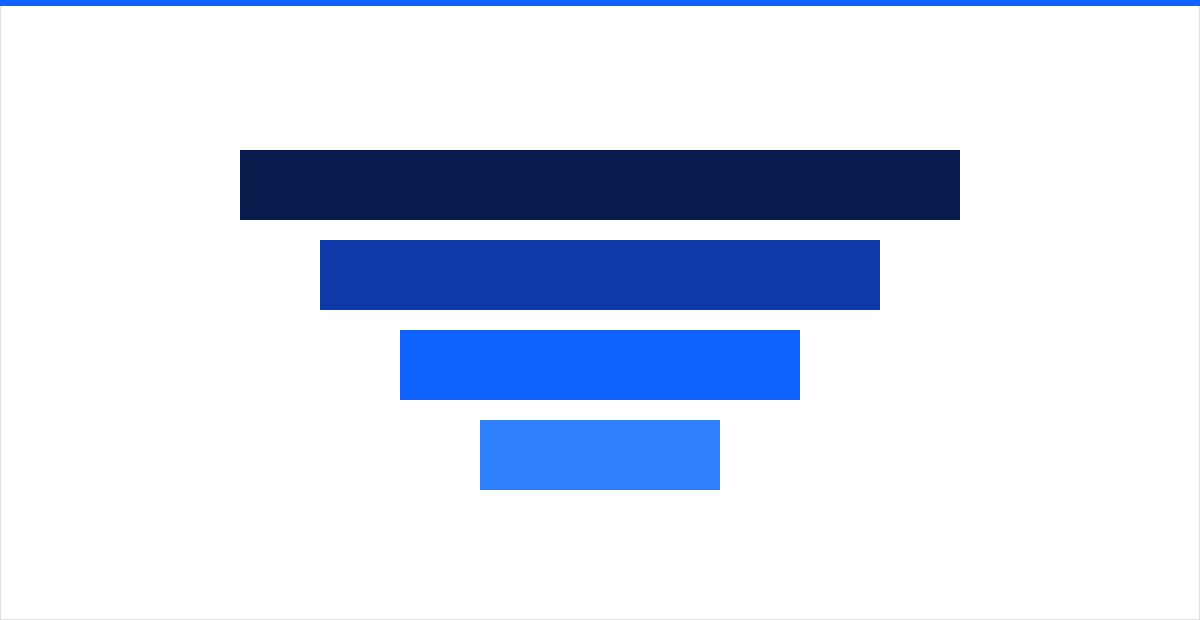 Figure: a CTI program is a funnel, not a firehose — millions of raw indicators are filtered, enriched with context, and analyzed down to the handful of findings that actually change a defensive decision.
The intelligence lifecycle
Mature CTI follows a repeatable cycle rather than passively consuming feeds. The steps are worth naming because skipping any of them is where programs break down.
- Direction. Start with the questions that matter — the priority intelligence requirements. What do decision-makers actually need to know? "Which ransomware groups target our sector and are we defended against their methods?" is a requirement. "Give me every IOC you have" is not. Everything downstream is scoped by this step, and programs that skip it drown in irrelevant data.
- Collection. Gather from sources aligned to those requirements — commercial feeds, open-source intelligence, information-sharing communities (ISACs), dark web monitoring, and your own internal telemetry, which is often the most relevant source of all.
- Processing. Normalize, deduplicate, and structure raw data into a usable form. Standards like STIX for representing intelligence and TAXII for sharing it exist so this can be automated.
- Analysis. The step that turns data into intelligence — a human (aided by tooling) adding context and judgment to answer the requirement. This is the part no feed can sell you and the part that creates the value.
- Dissemination. Deliver the finished intelligence to whoever will act on it, in the form they can use — a briefing for the board, a detection rule for the SOC, a blocklist for the firewall. Same underlying threat, three different products for three different consumers.
- Feedback. Ask whether the intelligence answered the question and adjust the requirements. The cycle repeats.
The lifecycle is what separates a program from a subscription. A subscription pushes data at you; a program pulls answers to questions you decided mattered.
Making intelligence operational
Intelligence only earns its cost when it flows into the systems and people that act on it. The integration points that turn CTI from a report into a defensive capability:
- Enrichment and prioritization. The highest-volume everyday use is decorating alerts with context — is this IP associated with a known actor, is this hash tied to active ransomware. This lets a security operations center triage by relevance instead of treating every alert as equal, which is one of the most direct ways CTI reduces analyst overload.
- Detection engineering. Operational intelligence about adversary TTPs, mapped to MITRE ATT&CK, drives the detections you build. Knowing which techniques your relevant threat actors use tells you which detections matter most — turning a generic ruleset into one aimed at your actual adversaries.
- Threat hunting. Intelligence gives hunts a hypothesis. Rather than searching aimlessly, an analyst hunts for the specific TTPs of an actor known to target the sector, in the systems that actor would target.
- Blocking and automated response. Vetted tactical indicators feed firewalls, EDR, and email security for automated blocking — with the caveat that IOCs must be current and trustworthy, since stale or low-quality indicators generate false positives that erode trust.
- Vulnerability prioritization. Intelligence on which vulnerabilities are being actively exploited in the wild — not merely which are severe — focuses vulnerability management on the small fraction of flaws attackers actually use.
Each of these is a decision the intelligence improved. If a feed touches none of them, it is not part of a program — it is a line item.
Quality over quantity
The instinct to add more feeds is almost always wrong. More sources mean more volume, more noise, more duplication, and more false positives — not more insight. A few well-chosen, high-quality, relevant sources beat a dozen generic ones. The disciplines that keep a program valuable:
- Relevance first. Intelligence about threats to a sector you are not in is noise. Weight collection toward the adversaries, geographies, and technologies that actually apply to you.
- Judge source quality. Feeds vary enormously in accuracy and timeliness. A source with a high false-positive rate does active harm by generating alerts that waste analyst time and train the team to ignore the feed.
- Prioritize your own telemetry. Your internal data — what has actually been seen in your environment — is frequently the most relevant intelligence you have, and it is free. An external feed matters most when correlated against what is happening inside your walls.
- Measure by decisions changed, not indicators ingested. The metric that matters is whether the intelligence improved a decision or an outcome, not the size of the feed.
Where to start
Do not start by buying feeds. Start by defining your priority intelligence requirements — write down the handful of questions your leadership and your SOC actually need answered. Then align a small number of relevant, high-quality sources to those questions, invest in the analysis step that turns data into answers, and wire the output into the specific decisions it should change: alert triage, detection priorities, hunts, and patch order. Add sources only when a requirement demands one, and cut any feed that no one acts on.
intSignal runs threat intelligence as an operational capability, not a subscription — requirements-driven collection, analysis mapped to your real adversaries, and integration into the detection and response and monitoring that turns intelligence into action. Talk to our security team and we will help you build a program measured by the decisions it improves, not the indicators it collects.