Synthetic Data: When It Helps Your ML and When It Hurts

What synthetic data actually is
Synthetic data is information generated by an algorithm rather than collected from the real world, built to stand in for real records while preserving their statistical shape. Done well, a synthetic dataset carries the same distributions, correlations, and edge cases as its source but contains no actual customer, patient, or transaction. Done badly, it is a confident-looking fake that teaches a model patterns that were never true.
The distinction that matters is not synthetic versus real — it is whether the synthetic data faithfully reflects the process that produced the real data. A model does not know or care where its training examples came from. It only learns the patterns present in what you feed it. That is the entire promise and the entire danger of synthetic data in one sentence: it is exactly as good, and exactly as biased, as the generator that made it. Treat it as a tool with a narrow, defensible job, and it earns its place in a production pipeline. Treat it as free data, and it quietly poisons the model you were trying to help.
Why teams reach for it
Four problems drive most legitimate synthetic-data work, and each is a real constraint that blocks a model from shipping:
- Privacy and regulation. Real records carrying PII or PHI cannot move freely into a development environment, a vendor's tooling, or an offshore team without triggering GDPR, HIPAA, or contractual obligations. A well-generated synthetic copy lets teams build and test without exposing the underlying people. This overlaps directly with data loss prevention: synthetic data is only a privacy win if it cannot be reverse-engineered back to the individuals it was derived from.
- Class imbalance. Fraud, defects, and churn are rare by definition. A dataset that is 99.5 percent normal and 0.5 percent fraud teaches a model that predicting "normal" every time scores 99.5 percent accuracy — technically true, operationally useless. Synthetic minority examples can rebalance the training set so the model actually learns the rare class.
- Rare and dangerous events. You cannot wait years to collect enough real examples of a specific equipment failure, and you certainly cannot stage real crashes to train a safety system. Simulation generates those scenarios on demand.
- Scarce or expensive labels. Hand-labeling images, tickets, or transactions is slow and costly. Synthetic generation can produce data that is labeled the moment it is created, because the generator already knows the answer.
None of these is a vanity project. Each is a case where the real data is unavailable, too rare, too sensitive, or too expensive — and where a synthetic stand-in is the difference between a model that ships and one that stalls.
How synthetic data gets made
Three families of techniques dominate, and they sit at very different levels of sophistication and risk.
- Simulation and rules. A physics engine, a network simulator, or a set of business rules generates data from a known model of the world. This is the workhorse for autonomous systems, robotics, and rare-event testing, and its great virtue is that every example arrives correctly labeled. Its weakness is the "reality gap" — the simulator only knows what its builders modeled, so anything they left out simply never appears in the data.
- Augmentation. You take real examples and transform them — rotate, crop, and recolor an image; inject noise or paraphrase text. Augmentation is cheap, well-understood, and widely used in computer vision and data analytics because it multiplies a small real dataset without inventing anything from scratch. It expands coverage around real data rather than replacing it.
- Generative models. GANs, variational autoencoders, and diffusion or language models learn the distribution of a real dataset and sample new records from it. This is the most powerful approach and the most dangerous: the output can be strikingly realistic, but the model can also memorize and leak real records, or amplify whatever skew existed in its training data.
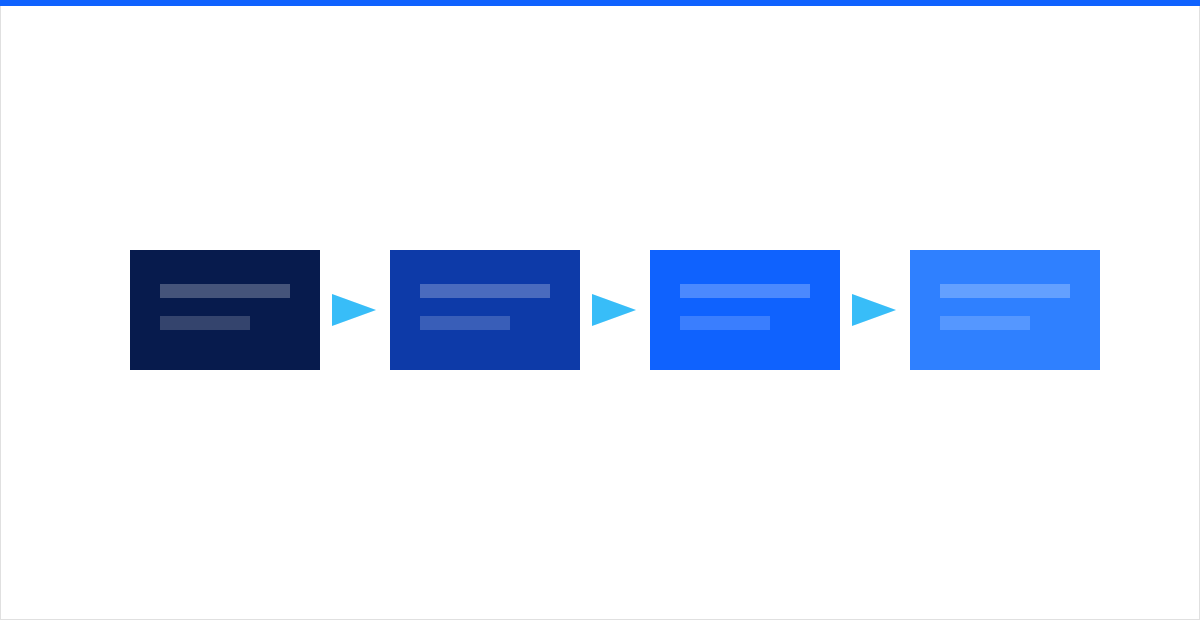 Figure: synthetic data is only as trustworthy as the validation gate between the generator and the model — skip it and errors flow straight into training.
The choice among these is not about which is most advanced. It is about how much you can afford to be wrong. Simulation and augmentation stay close to a known ground truth. Generative models venture furthest from it, which is exactly why they demand the most validation before their output touches a production model.
Where it goes wrong
The failure modes are specific, they compound quietly, and they rarely announce themselves with an error message.
- Bias amplification. A generator trained on skewed data does not neutralize the skew — it reproduces it, and often sharpens it. If the source under-represents a group, the synthetic data usually under-represents it further, and a downstream model inherits a bias that is now harder to trace because the offending records look manufactured rather than real.
- Model collapse. When models are trained on the output of previous models, generation after generation, the tails of the distribution erode. Rare cases disappear first, variance shrinks, and the data drifts toward a bland average. Recent research on training models on their own synthetic output shows quality degrading measurably with each cycle. This matters as more public data becomes itself model-generated: a naive pipeline can be quietly training on echoes.
- Distribution mismatch. The synthetic data looks plausible but its statistics do not match production. Correlations between features are lost, a variable's range is subtly off, or a combination that is common in reality never appears. The model performs beautifully in testing and then fails on live data, because it learned a world that does not exist.
- Overconfidence from volume. It is trivial to generate a million synthetic rows, and easy to mistake that volume for information. A million samples from a flawed generator contain no more real signal than the flawed generator itself — just more of the same error, harder to spot.
Validating synthetic data before you trust it
Synthetic data is a claim, and claims get tested. Before any generated dataset feeds a model that makes real decisions, put it through a gate:
- Fidelity. Compare distributions, correlations, and summary statistics between synthetic and real data. Per-feature histograms and cross-feature correlations should line up. Divergence here means the generator missed the shape of reality.
- Utility, tested the honest way. Train a model on synthetic data and evaluate it strictly on held-out real data — never on synthetic test data. This train-synthetic, test-real check is the single most useful signal you have, and it is the step teams most often skip.
- Privacy. Confirm the generator did not memorize real records. Check that no synthetic row is a near-duplicate of a real one, and run membership-inference style tests to confirm an attacker cannot tell whether a given real record was in the training set.
- Edge-case coverage. Verify the rare cases you generated the data for actually appear, at a realistic frequency, and are not degenerate copies of one another.
If a synthetic dataset cannot pass fidelity, real-data utility, and privacy together, it is not ready — regardless of how convincing it looks in a preview.
Where it helps and where real data is required
Synthetic data genuinely shines when the real data is off-limits or too rare to wait for: privacy-safe development and testing, rebalancing an imbalanced training set, augmenting scarce labeled images, and simulating dangerous scenarios you cannot stage. In these cases it unblocks work that would otherwise be impossible or illegal.
It is not a substitute for real data when the stakes are high and the ground truth is knowable. Final model validation should always run against real, held-out data. Regulated decisions in credit, hiring, and clinical settings need real evidence behind them, not simulated proxies. And any domain where the real distribution is poorly understood is a domain where a generator will confidently reproduce your misunderstanding. The reliable pattern is a blend: real data anchors truth, synthetic data extends reach, and real data always has the final say on whether the model is good enough to ship.
Where to start
Treat synthetic data as an engineered component with a specific job, a validation gate, and an owner — not as a shortcut around collecting real data. Name the exact constraint you are trying to solve, choose the lightest generation technique that solves it, and never let synthetic output reach production without passing fidelity, utility, and privacy checks against real data. intSignal builds and runs these pipelines as a managed machine learning and AI capability, from generation strategy through the validation that keeps synthetic data honest. If you have a model stalled on scarce, sensitive, or imbalanced data, talk to our team and we will help you decide where synthetic data helps and where only real data will do.