Natural Language Processing: Business Use Cases That Deliver

What NLP actually does in an operation
Natural language processing turns unstructured text into something a system can act on. Every organization sits on a mountain of it: support tickets, email threads, contracts, chat logs, incident notes, survey responses, knowledge-base articles. Most of that text is read once by one person and then buried. NLP is the set of techniques that reads it at scale, extracts the parts that matter, and routes the result into a workflow — a queue, a ticket field, a search index, a dashboard.
The useful mental model is a staged pipeline, not a single magic box. Raw text comes in, gets normalized and cleaned, then passes through one or more models that classify, extract, or summarize it, and finally lands as a structured output someone or something downstream consumes. Each stage is measurable and replaceable on its own. That is why NLP projects that treat the pipeline as the product succeed, and the ones that treat the model as the product tend to stall after a good demo.
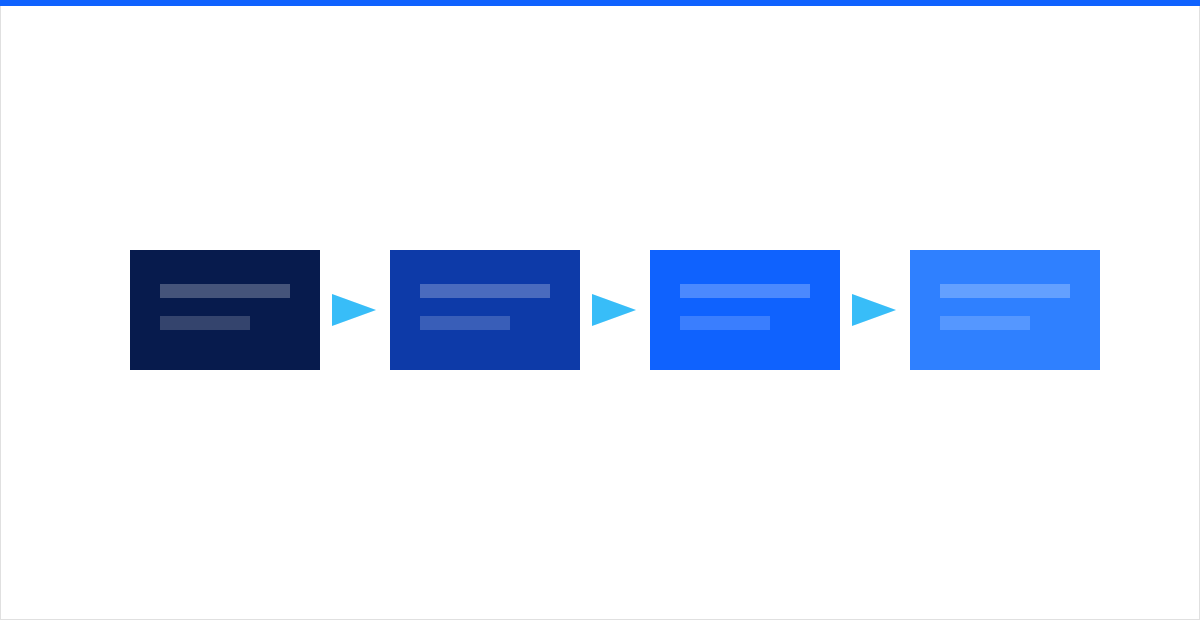 Figure: NLP is a staged pipeline — each step from ingestion to routing is measured and swapped independently, so the weakest stage is the one you fix.
Five use cases that earn their place
Classification and routing
The highest-volume, most reliable win is reading inbound text and deciding where it goes. A model reads a ticket or email and predicts category, priority, and the team most likely to resolve it, so triage happens in seconds instead of after a human first-touch read. This is textbook supervised learning: most organizations already hold years of resolved tickets tagged with where they went and how they closed. Start in shadow mode — the model suggests, a human confirms — and measure agreement before you let it auto-route the confident cases. Even handling the clear-cut 60 percent frees your best people for the ambiguous remainder that actually needs judgment. This pairs directly with a mature managed IT and help desk support practice, where consistent routing is the difference between a two-hour and a two-day resolution.
Entity extraction
Extraction pulls specific structured facts out of free text: the account number buried in an email, the affected hostname in an incident note, the renewal date in a contract, the CVE referenced in a vulnerability report. Instead of a human copying fields into a form, the model tags them and hands back clean data. The value compounds when the extracted entities feed another system — populating a CMDB, pre-filling a ticket, or linking a mention to the right asset. Extraction is where NLP quietly removes the most manual keystrokes.
Summarization
Long threads, sprawling incident timelines, and 40-message email chains cost time to read. Summarization condenses them into a few sentences a person can act on, or into a shift-handover note that captures what happened without the full transcript. The discipline here is scope: summarize a bounded, factual document and verify against the source. Summaries that invent detail are worse than no summary, which is exactly why the evaluation step below is not optional.
Sentiment and escalation signal
Sentiment analysis scores the tone of text — frustrated, neutral, satisfied — and its practical use is not a vanity dashboard. It is an early-warning signal. A ticket whose language turns sharply negative, or an account whose survey responses trend down over a quarter, is a churn risk or an escalation waiting to happen. Routing those to a human before they boil over is worth more than any aggregate score. Treat sentiment as a trigger, not a report.
Semantic and hybrid search
Keyword search fails when the user and the document use different words for the same thing. Semantic search represents meaning as vectors, so a question phrased one way finds an answer written another way — "my laptop will not connect to Wi-Fi" surfaces the article titled "resolving wireless adapter driver failures." In practice the strongest results come from hybrid search that blends keyword and semantic ranking, because exact matches on error codes and product names still matter. This is the retrieval layer underneath most internal knowledge assistants, and it is often the single change that makes a knowledge base people actually use.
Classic NLP versus large language models
Not every problem needs a large language model, and reaching for one by default is a fast way to overspend and add latency. The honest comparison:
- Classic NLP — smaller supervised classifiers, extraction models, and vector search — is cheap to run, fast, predictable, and easy to keep on your own infrastructure. It excels at high-volume, well-bounded tasks with clear labels: routing, tagging, sentiment, retrieval. You control it, you can explain it, and it does not hallucinate because it is not generating free text.
- Large language models shine when the task is open-ended, when phrasing varies wildly, or when you need fluent generated output — a drafted summary, a natural-language answer, extraction from messy formats a rigid model would miss. The tradeoffs are real: higher cost per call, more latency, a governance burden around what the model is allowed to say, and the risk of confident wrong answers.
A practical rule: if you can describe the answer precisely and you have labeled examples, a smaller classic model is usually cheaper, faster, and more auditable. Reserve the language model for the genuinely open-ended slice, and constrain it — retrieval-grounded, with a verification step — so it does not drift. Many mature systems use both: a fast classifier does the routing, a language model drafts the summary, and search grounds the answer in real documents.
Data and evaluation decide the outcome
Models fail on data far more often than on math. Before committing to any use case above, pressure-test the inputs and the way you will judge success.
- Labeled history. Supervised classification needs enough tagged examples — a few hundred per category, not a few dozen — and the labels must be consistent. If ten agents tagged tickets ten different ways, the model learns the inconsistency. Clean the taxonomy first; it is cheaper than any model.
- A held-out evaluation set. You cannot improve what you do not measure. Set aside labeled examples the model never trained on, and score against them.
- The right metric. Accuracy alone lies on imbalanced data. Track precision and recall per category, and decide which error is costlier — a misrouted ticket or one that needed a human but got auto-handled.
- Human evaluation for generation. Summaries and generated answers need a person spot-checking faithfulness to the source, because no automated score fully catches a fluent falsehood.
- Drift monitoring. Language changes as products, systems, and customers change. A model trained before a major migration quietly degrades. Monitor its accuracy in production the way you monitor a service, and plan to retrain.
None of this is glamorous, and all of it is where projects live or die. Teams that get value from NLP treat data readiness and evaluation as the project, not the prerequisite.
Integrating into the workflow
A model that produces a prediction nobody consumes is a science experiment. The value appears only when the output lands inside an existing workflow: the routing decision writes the ticket field, the extracted entity pre-fills the form, the summary posts to the handover channel, the sentiment score raises a flag. Ship in shadow mode first, measure against reality, and widen the model's authority only as it earns trust — keeping a human in the loop for anything consequential. Every correction an engineer makes is a free label that improves tomorrow's model, so capture the correction, not just the prediction.
Where to start
Pick one high-volume text decision your team makes dozens of times a day, confirm you already hold the data behind it, and build the smallest pipeline that improves that one decision. intSignal designs and runs these systems as a managed capability, from machine learning and AI strategy through the data analytics foundation, modeling, evaluation, and the workflow integration that turns a model into a durable capability. If you have a mountain of text that should be doing more work, talk to our team and we will help you find the use case worth building.