Multi-Cloud Networking: Connecting Without the Chaos

Why connecting clouds is harder than connecting data centers
Stitching two data centers together is a solved problem: you own both ends, the address plan is yours, and the constructs are the same on each side. Multi-cloud breaks all three assumptions at once. Each provider hands you a different virtual network primitive, a different routing model, a different firewall abstraction, and a metered bill for traffic that leaves its boundary. The result is that teams who ran a clean on-premises network for a decade suddenly find themselves with duplicated tooling, unreachable subnets, and an egress line item nobody forecast.
The connectivity problem is rarely the reason organizations go multi-cloud — acquisitions, a best-of-breed data platform on one hyperscaler, or a resilience mandate usually are. But networking is where the strategy either becomes a coherent estate or a set of islands with expensive bridges. Getting it right comes down to five decisions: how you interconnect, how you plan addressing, how you enforce consistent segmentation and identity, how you resolve names, and how you see across the whole thing.
The three problems that appear first
Overlapping CIDRs
The most common failure is banal and painful: two clouds — or a cloud and the on-premises range — were built independently, both using RFC 1918 space, and both landed on the same block. Now you cannot route between them without translation, because a packet destined for 10.0.1.0/24 has two valid destinations. Once workloads are live in overlapping space, the fixes are all ugly: renumber a production network, or bolt on NAT that obscures source addresses and breaks the identity and logging you rely on for security.
The only real cure is prevention. Maintain a single authoritative IP address plan that spans every cloud, every region, and on-premises, and carve non-overlapping ranges out of it before a single subnet is created. Reserve generously — address space is free, renumbering is not — and never let a team stand up a VPC or VNet with a default range.
Inconsistent constructs
The same idea has a different name and different behavior on each platform. One provider's virtual network is regional and spans availability zones; another's is zonal. Route tables, security groups, network ACLs, peering, and transit constructs all differ in scope, default-deny behavior, and how they compose. A rule that means "allow" in one model can mean something subtly different in another. Teams that try to hand-map every construct one to one burn out fast.
The durable answer is to stop managing these by hand. Define network topology, firewall policy, and routing as code so the same intent renders into each provider's primitives, and so a change is reviewed, versioned, and repeatable rather than clicked into a console at 2 a.m.
Egress that surprises the finance team
Traffic inside a cloud is usually cheap or free; traffic that crosses a provider's boundary is billed, often per gigabyte, and inter-region and inter-cloud paths cost more than most architects expect. A chatty service mesh spanning two clouds, or backups replicated across providers, can quietly generate a five-figure monthly charge. Treat data-transfer cost as a first-class design input: keep tightly coupled services on the same side of a boundary, place data next to the compute that reads it most, and measure real flow volumes before you commit to a topology that assumes traffic is free.
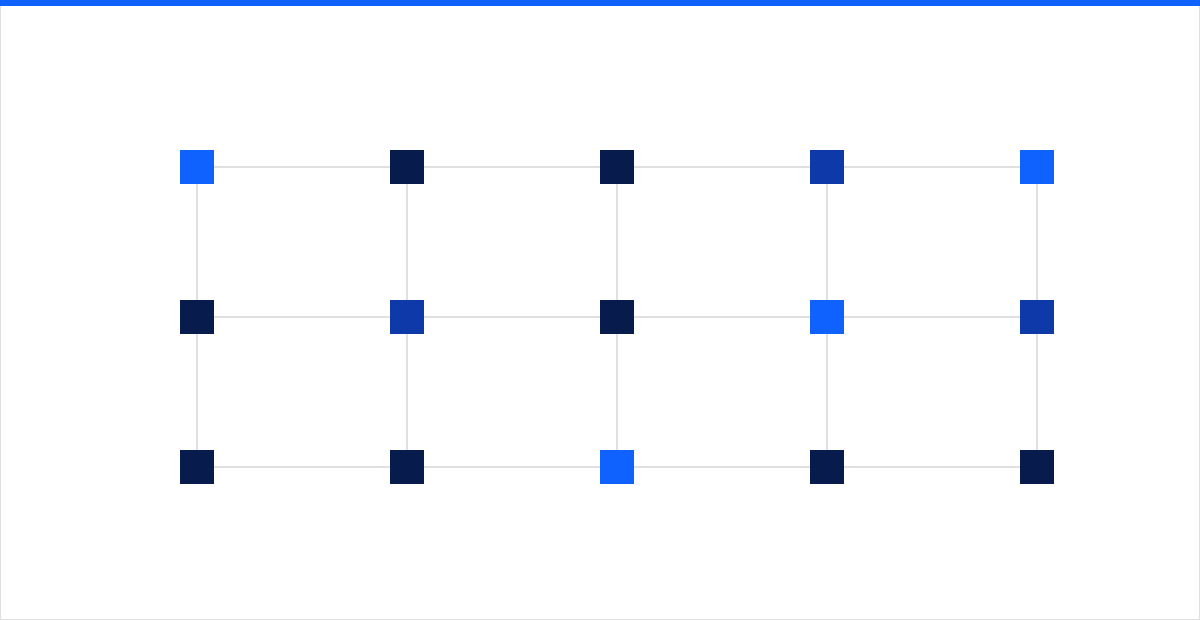 Figure: the goal is one logical fabric across providers — not a set of islands wired together by hand, each with its own addressing, policy, and blind spots.
Interconnect options, and when each fits
There is no single right way to join clouds. The choice depends on bandwidth, latency sensitivity, security posture, and how many endpoints you are joining.
- Encrypted VPN over the internet. Fastest to stand up and lowest cost. Fine for modest bandwidth, non-latency-sensitive traffic, and early-stage connectivity. The tradeoffs are variable internet latency and throughput ceilings on the tunnels. A reasonable default for a first link.
- Dedicated interconnect. A private circuit into each provider's edge delivers predictable latency, higher and more consistent throughput, and traffic that never touches the public internet. It costs more and takes weeks to provision, so reserve it for production data paths, large replication flows, or anything with a latency budget you cannot miss.
- Cloud routers and transit hubs. Rather than a tangle of point-to-point peerings — which grows as the square of the number of networks — route through a central transit construct or a colocation-based routing hub. This is the hub-and-spoke pattern: each cloud and site connects once to the hub, and the hub handles transit, policy, and route propagation. It scales far better than a full mesh of peerings and gives you one place to enforce controls.
- SD-WAN and SASE overlay. An overlay abstracts the underlying transport entirely: branch sites, data centers, and cloud on-ramps all join one policy-driven fabric, and the overlay picks the best path per application. This is the strongest fit when you have many sites plus multiple clouds, because it unifies branch connectivity and cloud interconnect under one control plane. Our SD-WAN and global networks practices build exactly this kind of transport-independent fabric.
Most mature estates end up combining these: dedicated interconnect for heavy production paths, VPN for lower-tier links, a transit hub to avoid peering sprawl, and an overlay tying in the edge.
Consistent segmentation and identity across providers
Connectivity without consistent policy is just a bigger attack surface. The principle that keeps a multi-cloud network defensible is the same one that governs any good network: segment so that a compromise in one zone cannot move laterally into another. The hard part is enforcing that identically across platforms whose firewall and IAM models do not match.
- Define segmentation as intent, not as per-cloud rules. Express zones and the allowed flows between them once, then render that policy into each provider's constructs. When the intent lives in one place, a gap on one cloud that does not exist on another — the gap an attacker looks for — stops appearing.
- Anchor access in identity, not network location. Being on the corporate network should grant nothing by itself. A zero-trust model that authenticates and authorizes every request works across clouds because it does not depend on any one provider's perimeter.
- Unify posture management. Misconfiguration, not exotic exploits, drives most cloud breaches, and every additional provider multiplies where a bad rule can hide. Continuous cloud security posture management spanning all providers catches the drift before an attacker does.
- Push enforcement to the edge with SASE. A secure access service edge fabric applies the same access, inspection, and data-protection policy whether a user is reaching a workload on one cloud or another, which is what keeps policy consistent as the estate grows.
DNS and name resolution across clouds
Names are where multi-cloud connectivity quietly falls apart. Each provider runs its own private DNS for internal service discovery, and by default those zones do not resolve across the boundary. A service on one cloud simply cannot find one on another by name. Solving it takes deliberate design:
- Run a resolution layer that forwards queries between each cloud's private zones and any on-premises DNS, so a name resolves the same way everywhere it is asked.
- Keep a clear split between public and private zones, and make sure internal names never leak into public resolution.
- Standardize a naming convention across providers so that where a workload runs is not baked into its name — that is what lets you move or fail over a service without rewriting every consumer.
Get DNS right early. It is cheap to design up front and disproportionately painful to retrofit once hundreds of services hardcode addresses because resolution "didn't work."
Observability across the fabric
During an incident, the worst position is debugging blind across a boundary because each cloud's metrics, logs, and flow records live in a separate console. You cannot trace a request that crosses providers if no single view follows it. Normalize telemetry — flow logs, latency, packet loss, and firewall decisions — into one platform so you can see the end-to-end path, not three disconnected segments. Pair that with active path monitoring so you learn about a degraded interconnect from your own alerts rather than from users, so a cross-cloud dependency does not become an invisible single point of failure.
Bringing order to the estate
Multi-cloud networking is not one big problem; it is five smaller ones that compound when handled ad hoc. Plan addressing centrally so CIDRs never collide. Manage topology and policy as code so constructs stay consistent. Choose interconnect by bandwidth, latency, and scale — and route through a hub before a mesh of peerings sprawls. Enforce segmentation and identity uniformly, resolve names across boundaries, and watch the whole fabric from one place. Do those, and multi-cloud is a coherent network. Skip them, and it is islands with a bill.
If your estate has grown across providers faster than the network design underneath it, that is where intSignal starts. Talk to our team about designing consistent global networks across your clouds, or contact us to map your addressing, interconnect, and segmentation before the next overlapping subnet forces a renumber.