Multi-Region Architecture: Designing for Regional Failure

A single region is a single point of failure
Teams that would never run production on one server happily run it in one cloud region and call it resilient. The reasoning is that the region already spreads workloads across isolated datacenters, so what more could go wrong? The answer, repeatedly, is: the whole region. Every major provider has had full-region disruptions — control-plane failures, capacity events, botched configuration changes, and physical incidents — that took down every availability zone at once, because they shared a dependency no customer could see.
When that happens, redundancy inside the region does not save you. Your load balancer, your database failover, your object storage, and the very APIs you would use to launch replacement capacity are all in the region that just went dark. A regional outage is not a bigger server outage; it is a different class of event, and surviving it requires infrastructure that lives somewhere else entirely. That is what multi-region architecture is for, and it is one of the most consequential — and expensive — decisions in a cloud design.
A multi-region system is a hub and spoke
However you deploy a second region, users have to be routed to whichever region is healthy, and that routing layer is a hub-and-spoke system: a global traffic manager at the center directing every request to a live regional deployment, and draining one the moment it fails.
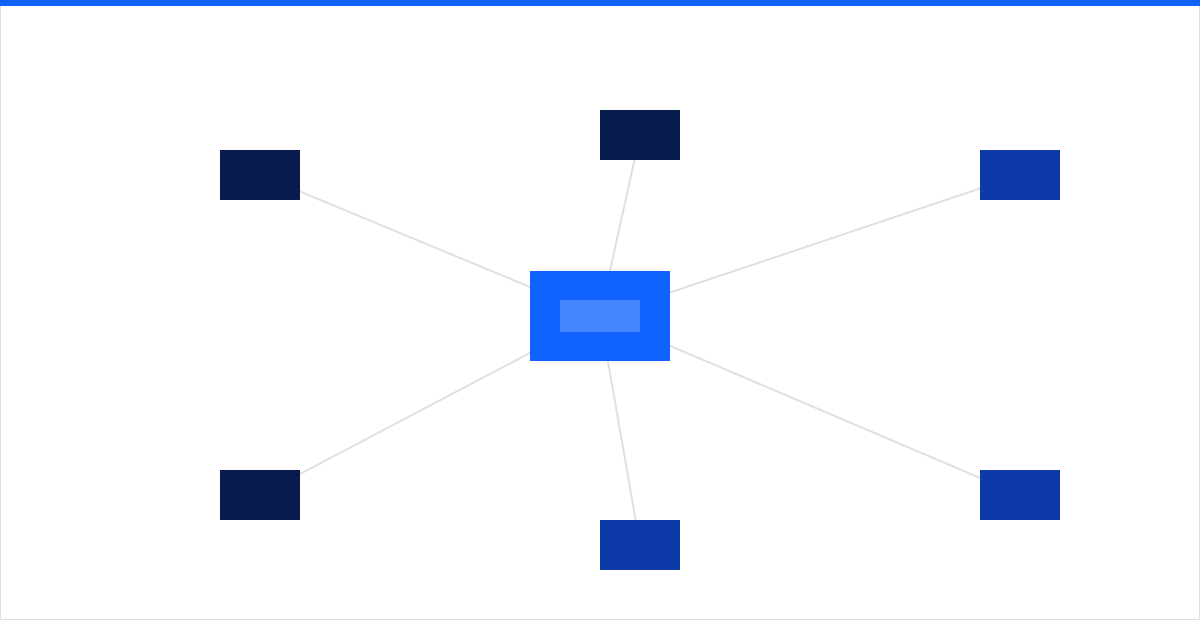 Figure: the global load balancer is the hub and each region is a spoke — failover is only as fast as the hub notices a spoke is unhealthy and stops routing to it.
Two mechanisms carry that traffic, and their limits define your real failover time:
- DNS-based failover uses health checks to hand out the address of a healthy region. It is simple and provider-agnostic, but bounded by DNS caching: clients and resolvers honor the record's TTL, and some ignore it, so a five-minute TTL can leave a tail of users hitting the dead region long after you failed over. Keep TTLs short for failover-critical records, but not so short that resolver load becomes its own problem.
- Anycast global load balancers advertise a single IP from every region and steer at the network layer, so failover does not wait on client DNS caches. Convergence is far faster, at the cost of a provider-specific, pricier service.
Whichever you use, failover is only as good as the health check behind it. Check a deep endpoint that exercises the application and its database, not a static page that stays green while the service is broken. Then test that a failed check truly drains the region — untested failover routing is the most common reason a well-architected multi-region design still goes down.
Availability zones are not regions
Before designing the spokes, clear up the most common and costliest misconception: that multi-AZ is geographic resilience. It is not.
- An availability zone is one or more physically isolated datacenters inside a region, with independent power, cooling, and networking, connected to its sibling zones by low-latency private links. Multi-AZ deployment protects you against a rack, a datacenter, a power domain, or a single-zone network failure. It is table stakes, and every production workload should use it.
- A region is a geographic cluster of those zones, sharing a regional control plane, regional service endpoints, and often a metro-scale fate. Multi-region deployment protects you against the loss of that entire cluster — a control-plane failure, a regional service degradation, or a natural disaster affecting the area.
Zones inside a region fail in correlated ways. They share the regional API, regional identity, and regional managed services, and a bad change or an overloaded control plane can affect all of them together. Spreading across three zones gives excellent protection against localized faults and none at all against a regional one. If your objective is to survive the loss of a region, only a second region delivers it.
Active-passive versus active-active
The next question is how much of the second region runs, and when. This is a spectrum of standby readiness, and the two anchors are active-passive and active-active.
Active-passive keeps a secondary region on standby and promotes it only when the primary fails.
- Warm standby runs a scaled-down but functional copy at all times, ready to take traffic and scale up. Pilot light keeps only the core alive — the database replicating, networking configured — with application tiers pre-built but switched off until needed.
- Recovery is a deliberate failover: promote the database, scale the compute, repoint traffic. Expect an RTO of minutes to tens of minutes and an RPO tied to replication lag.
- It is simpler to reason about because writes only ever happen in one place, and it is cheaper because the second region is not carrying full load.
Active-active runs the workload live in two or more regions at once, all serving traffic.
- If a region fails, the survivors absorb its share, often with no human intervention — RTO and RPO approach zero.
- The price is steep engineering complexity: you must handle writes in multiple regions simultaneously, which means solving data consistency and conflict resolution rather than avoiding them.
- You also pay for full capacity in every region, sized so each can carry the others' load during a failure, not just its own steady state.
Most organizations do not need active-active for most workloads. The honest default is multi-AZ everywhere, active-passive for the systems that cannot tolerate a regional outage, and active-active reserved for the handful of tier-0 services where even minutes of downtime carry material or regulatory cost. Matching the pattern to the workload, rather than applying one everywhere, is where managed backup and disaster recovery design lives or dies.
Data replication and consistency is the hard part
Compute is easy to duplicate; state is not. The moment your data exists in two regions, physics and the CAP theorem start setting the rules, and no tooling repeals them.
- Synchronous replication confirms every write in both regions before acknowledging it. Your data is always consistent and your RPO is effectively zero — but every write pays the cross-region round trip. A transcontinental hop is roughly 60 to 100 milliseconds, so synchronous replication across distant regions can make writes unusably slow. It only works between nearby regions, and even then it caps throughput.
- Asynchronous replication acknowledges the write locally and ships it to the second region a moment later. Write latency stays low, but the secondary always lags the primary, so a sudden failure loses the last few seconds of in-flight transactions. Your RPO equals your replication lag — acceptable for most systems, unacceptable for a payment ledger.
- Active-active writes are the deepest water. When both regions accept writes to the same records, you must resolve conflicts — last-writer-wins, vector clocks, CRDTs, or application merges — and guard against split brain, where a network partition lets both regions believe they are authoritative and diverge.
The practical guidance is to move as little writable state across regions as possible, keep a clear system of record per data domain, and choose replication mode per workload against its real RPO. Consistency is not a setting you turn on; it is a tradeoff you design around your data.
The real cost and complexity
Multi-region is not a feature you enable; it is an ongoing tax. Be clear-eyed before committing:
- Duplicated infrastructure. A second warm or active region can add 50 to 100 percent to the compute and database spend for the covered workloads.
- Cross-region data transfer. Replication and inter-region traffic incur egress charges that are easy to underestimate and grow with data volume.
- Operational overhead. Two regions mean two of everything to patch, monitor, and keep from drifting apart. The standby you never exercise quietly diverges from production until the day you actually need it.
- Testing discipline. A failover path that is never rehearsed is a hope, not a capability. Regular, scheduled region-failover drills are the only proof your RTO is real.
Match the architecture to your RPO and RTO
The way to control all of this is to stop treating multi-region as a yes-or-no switch and treat it as a per-workload decision driven by two numbers. Define, for each system, how much data you can lose (RPO) and how long you can be down (RTO), then buy the cheapest pattern that meets them:
- Generous RPO and RTO — internal tools, batch systems: multi-AZ plus cross-region backups is enough.
- Minutes of RTO, seconds to minutes of RPO — customer-facing revenue systems: active-passive warm standby with asynchronous replication.
- Near-zero RPO and RTO — tier-0, regulated, or material systems: active-active, with the full weight of consistency engineering that implies.
This tiering is exactly the discipline that connects resilient architecture to business continuity — keeping the organization running, not just the servers. intSignal designs, builds, and operates multi-region cloud architectures matched to defensible recovery objectives, and rehearses the failover so it works when it counts. Talk to our cloud team to pressure-test your single-region risk and design a plan you have actually proven.