Model Monitoring and Drift: Keeping ML Honest Over Time
A model's best day is the day it ships
The uncomfortable truth about production machine learning is that accuracy is not a property you achieve once. It is a property that decays. A fraud model validated at 0.94 AUC in offline testing does not hold that number forever — it holds it against the world as it looked in the training window. The world moves, and the model does not move with it. Left unattended, a high-performing model quietly becomes an average one, then a liability, and often no one notices until a downstream business metric slips.
This is not an edge case. It is the default behavior of every model that touches live data. Payment patterns shift, attackers change tactics, a marketing campaign changes who visits the site, a sensor gets recalibrated, an upstream team renames a field. None of these events throw an error. The pipeline stays green, the model keeps returning confident predictions, and the predictions keep getting worse. Model monitoring exists to make that silent decay visible before it costs you.
The three kinds of drift, and why they are different problems
"Drift" is not one thing. Conflating its varieties is the most common reason monitoring programs miss the failure they were built to catch. There are three distinct phenomena, and each demands a different response.
- Data drift (covariate shift). The distribution of the inputs changes while the underlying relationship between inputs and outcome stays the same. More traffic from a new device type, a shift in the average transaction size, a demographic the model rarely saw in training. The mapping is still valid; the model is simply operating in territory it was not trained on, where its accuracy is unverified.
- Concept drift. The relationship between inputs and the target changes. The same input that meant "low risk" last quarter now means "high risk." This is the dangerous one because the inputs can look completely normal — no input monitor will flag it — while the model is now systematically wrong. Fraud, churn, and threat detection are riddled with concept drift because an adversary or a market is actively changing the rules.
- Label drift (prior shift). The distribution of the outcome itself changes — the base rate of the positive class rises or falls. A model calibrated to a 2 percent fraud rate produces poorly calibrated probabilities when the true rate moves to 5 percent, even if nothing else changed.
The reason to separate them is remediation. Data drift may just need a wider training set. Concept drift needs fresh labels and retraining, and no amount of input monitoring alone will catch it. Label drift often needs recalibration rather than a full rebuild. If your monitoring cannot tell these apart, it cannot tell you what to do.
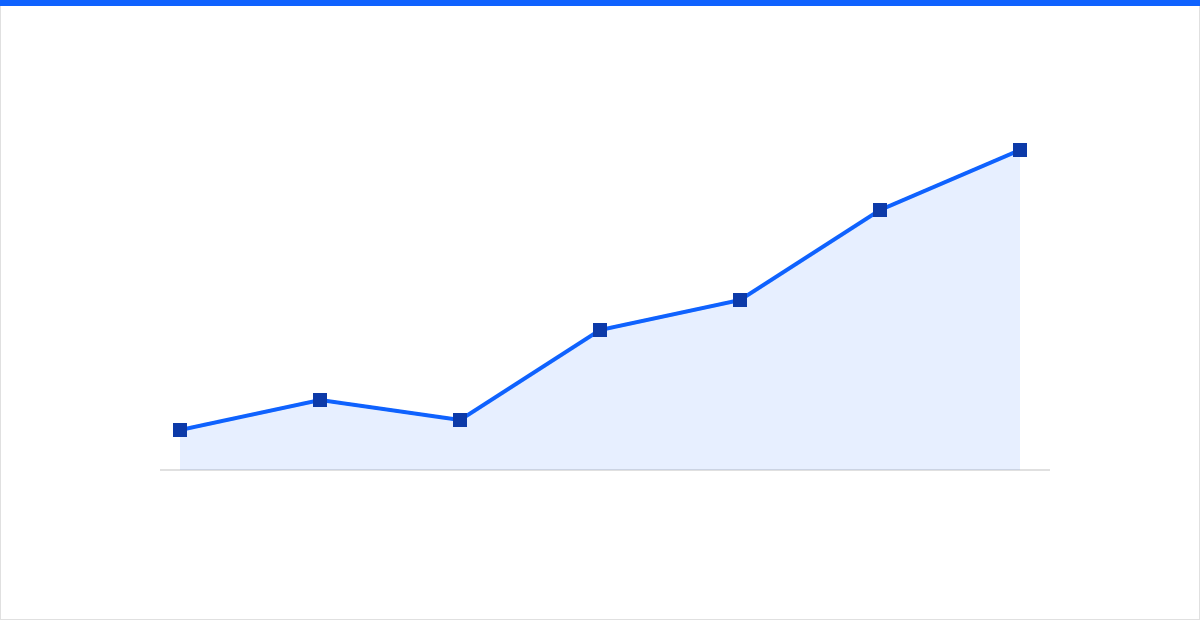 Figure: decay is usually gradual, so the signal is the trend line — not any single day's score.
Monitor in layers, because ground truth arrives late
The hardest constraint in model monitoring is timing. The metric you actually care about — was the prediction correct — requires the true label, and labels almost always arrive later than the prediction. You learn whether a loan defaults months after you approved it. You learn a transaction was fraudulent when the chargeback posts weeks later. Some labels never arrive at all. So you cannot wait for accuracy to tell you something is wrong. You monitor in layers, from the signals you have immediately to the ones you get eventually.
- Input features (available instantly). Track the distribution of every important feature against a training-window baseline. Watch for range violations, a spike in nulls or defaults, sudden cardinality changes in categoricals, and shifts in mean or variance. This is your earliest warning and catches data drift and broken upstream pipelines — the most common real-world failure.
- Predictions (available instantly). Monitor the distribution of the model's own outputs. If a scoring model that normally centers around 0.2 suddenly centers around 0.5, something changed even before you know if it is right. Score distribution, class balance of decisions, and average confidence are cheap, fast, and surprisingly effective proxies.
- Performance (available when labels land). When ground truth arrives, compute the metrics that matter — precision, recall, AUC, calibration error, mean absolute error for regressors — and trend them over time, not just as a single number. Where labels are slow, use delayed evaluation windows and any available proxy label to bridge the gap.
- Business KPIs (the metric that pays the bills). Ultimately the model exists to move a number: fraud dollars caught, false declines avoided, tickets auto-resolved, downtime prevented. Watch that number, because it can degrade from causes a purely statistical monitor will miss, and it is the metric your stakeholders actually feel.
A monitoring program that only checks accuracy is blind for as long as labels take to arrive. A program that only checks inputs is blind to concept drift. You need both ends of the pipeline and the middle. This is the same layered discipline our machine learning and AI teams apply to any model we put into production for a client.
Detecting drift without drowning in false alarms
Once you decide what to watch, you need a statistically sound way to decide when a change is real. The workhorse methods:
- Population Stability Index (PSI) for feature and score distributions. A common rule of thumb treats a PSI below 0.1 as stable, 0.1 to 0.25 as a moderate shift worth investigating, and above 0.25 as a significant shift. It is simple, interpretable, and easy to trend.
- Kolmogorov-Smirnov and chi-squared tests for comparing a current window against the baseline distribution — KS for continuous features, chi-squared for categorical.
- Kullback-Leibler and Jensen-Shannon divergence for a smooth, bounded measure of how far a distribution has moved.
- Performance change detectors such as DDM or the Page-Hinkley test, which watch the error stream itself and signal when the error rate departs from its established level.
The engineering challenge is not running these tests — libraries do that. It is avoiding alert fatigue. Test enough features frequently enough and something will always cross a threshold by chance. The disciplines that keep monitoring credible: compare against a stable reference window rather than yesterday, require a shift to persist across several windows before paging anyone, weight alerts by feature importance so a wobble in a feature the model barely uses does not wake someone at 2 a.m., and tier your responses — a dashboard note for a moderate PSI, a real page only for a sustained performance drop. The same alert-tuning philosophy we bring to infrastructure monitoring applies here: a monitor no one trusts is a monitor no one reads.
Turning a drift signal into a retraining decision
Detecting drift is only useful if it triggers action. The naive answer — retrain on a fixed calendar — is wasteful when nothing has changed and too slow when everything has. Mature programs use a mix of triggers:
- Performance-triggered. Retrain when a monitored metric crosses a predefined floor. The most defensible trigger, because it responds to actual degradation, but it depends on labels arriving fast enough to matter.
- Drift-triggered. Retrain when input or prediction drift exceeds threshold, used as a leading indicator when labels are slow — you act on the early signal rather than waiting for confirmed damage.
- Scheduled. A regular cadence as a safety net so a model never runs unattended for a quarter, layered on top of the reactive triggers rather than replacing them.
Whatever fires the retrain, the pipeline behind it has to be trustworthy, because retraining on drifted data can bake in a problem rather than fix it. A sound retraining pipeline validates and versions the new training data, retrains and evaluates the candidate against a held-out set, and — critically — compares the candidate to the incumbent before promotion. A model that is worse than the one in production should never ship, so a champion-challenger gate belongs in the pipeline. Roll out with a shadow or canary phase, keep the previous version ready for instant rollback, and version data, model, and metrics together so any prediction can be traced to the exact model and data that produced it. For teams standing up computer vision, the same loop applies with an added twist: image drift from new cameras, lighting, or lenses is a leading cause of silent failure, which is why our data analytics and computer vision work treats input monitoring as part of the deliverable, not an afterthought.
Ship the monitoring, not just the model
The organizations that get durable value from machine learning are not the ones with the cleverest architectures. They are the ones that treat a deployed model as a system that needs operating — instrumented, watched, and refreshed on evidence rather than hope. A model without monitoring is a decision engine you have stopped checking, and its accuracy is decaying whether or not you are looking.
If you are running models in production without a clear answer to "how would we know if this got worse," that is the gap worth closing first. intSignal builds the monitoring, alerting, and retraining pipelines that keep models honest over time, grounded in the same machine learning and AI practice we bring to every engagement. Talk to our team and we will start by making your models' decay visible.