Edge Computing: Where It Earns Its Place

Why compute is moving back toward the data
For fifteen years the direction of travel was one way: consolidate everything into a handful of large cloud regions and let the network carry the traffic. That model is still correct for most workloads. But a growing class of applications breaks when compute sits hundreds of milliseconds away from where data is produced and consumed, and for those, moving processing closer to the source — the edge — is not a trend to chase but an engineering requirement. Five forces drive the decision, and a workload usually qualifies for the edge when two or more of them apply at once.
- Latency. Physics sets a floor. A round trip across the continent is roughly 60 to 80 milliseconds before you add processing, and a trip to a distant region can exceed 100. For a video call or a web page that is invisible. For a robot arm, an autonomous vehicle, a trading path, or a machine-vision quality check on a production line, tens of milliseconds is the difference between working and not. Edge compute keeps the control loop local.
- Bandwidth cost. A single high-resolution camera or a dense sensor array can generate terabytes a day. Shipping all of it to a central region to be analyzed, then discarded, is expensive and often pointless. Processing at the edge and sending only the results — an alert, a count, a model inference — collapses the data volume by one or two orders of magnitude before it ever touches a wide-area link.
- Resilience. An edge site that can keep operating when its uplink drops is a site that keeps making product or serving customers during an outage. A store, a factory, or a clinic should not go dark because a carrier had a bad afternoon.
- Data gravity. Large, continuously growing datasets are hard to move. It is frequently cheaper and faster to bring compute to the data than to haul the data to the compute, especially when the data is regenerated constantly and only a fraction of it has lasting value.
- Privacy and compliance. Keeping regulated or sensitive data — biometrics, patient monitoring, personally identifiable video — processed locally, with only anonymized or aggregated results leaving the site, shrinks both the compliance scope and the blast radius if something goes wrong.
Edge and cloud form a hub and spoke
The most common mistake is framing this as edge versus cloud. In practice the two are one system: distributed edge nodes handle the fast, local, latency-bound work, and a central cloud handles aggregation, long-term storage, model training, fleet orchestration, and the analytics that benefit from seeing every site at once. The topology is a hub and spoke — many edge sites reporting to and governed by a central control plane.
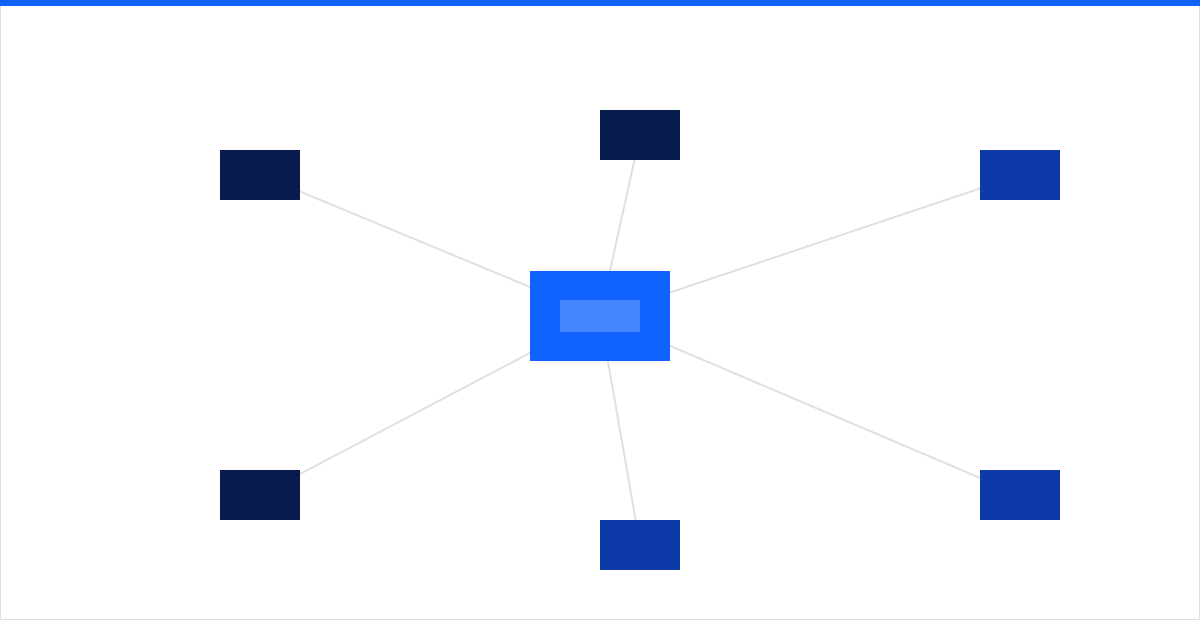 Figure: the edge handles the millisecond-scale local loop while the cloud hub owns training, aggregation, and fleet-wide policy — each does what the other cannot.
Getting the division of labor right is the whole game. Inference runs at the edge; training runs in the cloud, where the compute and the full dataset live, and updated models are pushed back out to the spokes. Raw telemetry is filtered locally; distilled signal flows to the hub. Policy, configuration, and identity are defined centrally and enforced everywhere. When the split is clean, an uplink outage degrades a site gracefully instead of stopping it. When it is muddy — when an edge node cannot make a decision without a cloud round trip — you have inherited the latency and fragility of a centralized design while paying for distributed hardware. This is why an edge program should be planned as part of your broader cloud infrastructure strategy, not as a side project bolted on afterward.
Where the edge earns its place
The pattern repeats across industries: keep the time-critical loop local, send the summary upstream.
- Retail. A store runs point-of-sale, inventory, loss-prevention video analytics, and increasingly self-checkout entirely on in-store compute so it keeps trading through an internet outage. Corporate gets nightly sales, shrinkage, and footfall data — not the raw camera feeds. Multiply by a few hundred locations and the bandwidth savings alone justify the architecture.
- Manufacturing and IoT. Predictive maintenance, machine-vision defect detection, and safety interlocks demand deterministic, sub-frame response. Sending vibration or camera data to a distant region and waiting for a verdict is not viable when a defective part is moving down the line every few seconds. The edge node makes the call in real time; the cloud accumulates the history that improves the model.
- Content delivery. The original edge use case. CDN nodes cache and serve content — and now run code and personalization logic — from points of presence close to users, cutting latency and offloading origin servers. This is edge computing at internet scale, and it rides on the same distributed footprint as a well-designed global network.
- Real-time inference. Running a trained model where the data is generated — a camera, a kiosk, a medical device, a vehicle — gives instant results, avoids streaming sensitive input off-site, and keeps working when connectivity does not. The cloud handles retraining and fleet-wide model rollout; the edge handles the prediction that has to happen now.
The hard part is managing the fleet, not the node
A single edge box is easy. A thousand of them, spread across sites with no IT staff, physically reachable by anyone, and each a small computer running real workloads, is a genuinely harder operational and security problem than a consolidated data center. This is where edge programs succeed or quietly rot, so budget for it from the start.
- Provisioning and updates at scale. You need zero-touch provisioning and a reliable, staged remote-update pipeline. Pushing firmware, OS patches, and model updates to a fleet without bricking sites — and without a truck roll — is a discipline, not an afterthought. Roll updates in waves with automatic rollback, never all at once.
- A wider attack surface. Every edge location is a potential entry point, and many sit in physically uncontrolled spaces where an attacker can touch the hardware. Treat each node as untrusted: full-disk encryption, secure boot, strong device identity, and mutual authentication back to the hub. Segment edge networks so a compromised node cannot pivot into the core, and fold the whole footprint into your attack-surface and asset inventory rather than leaving it as a blind spot.
- Visibility across every site. You cannot secure or operate what you cannot see. Centralized infrastructure monitoring that reports health, performance, and security telemetry from every node into one view is non-negotiable — during an incident, blind spots at the edge are where dwell time hides.
- Graceful degradation. Design every site to keep doing its core job when the link to the hub is down, then reconcile state when it returns. A site that stops working the moment it loses connectivity defeats the resilience argument that justified the edge in the first place.
A short readiness checklist
Before committing to an edge deployment, confirm you can answer yes to each:
- Is the workload genuinely latency-bound, bandwidth-heavy, or resilience- critical — or would a nearby cloud region do?
- Can each site operate autonomously when its uplink fails, and reconcile afterward?
- Do you have zero-touch provisioning and staged, reversible remote updates?
- Is every node hardened, encrypted, and cryptographically identified?
- Does one console show health and security across the entire fleet?
- Is the split between edge and cloud responsibilities written down and clean?
If several answers are no, the honest move is to fix the operating model before adding hardware in the field — not after.
Putting the edge to work
Edge computing is not a replacement for the cloud and it is not right for most workloads. It is the correct answer for a specific, growing set of problems where latency, bandwidth, resilience, data gravity, or privacy make centralized compute untenable — and it pays off only when the distributed fleet is engineered to be managed and secured as rigorously as the data center it extends.
intSignal designs and operates edge computing architectures end to end: choosing what belongs at the edge versus the hub, hardening and monitoring the fleet, and wiring it into your existing cloud and network estate so it behaves as one system. If you are weighing whether a workload belongs at the edge — or already have edge sites that have outgrown how you manage them — talk to our team for a straight assessment before the fleet becomes someone's full-time firefight.