Edge AI: Running Inference Where the Data Is

Why inference belongs at the edge
Training a model and running it are two different jobs with different homes. Training is a heavy, occasional batch process that belongs in the cloud, where the compute and the full dataset live. Inference — the moment a trained model turns an input into a prediction — happens constantly and in real time, and increasingly the right place to run it is not a distant cloud region but the device sitting next to the camera, sensor, or user that produced the data. That is edge AI: pushing the prediction to where the data is, and sending only the result upstream.
Four forces make this the right call for a growing class of workloads, and a workload usually qualifies when two or more apply at once.
- Latency. A cross-country round trip to a cloud region is roughly 60 to 100 milliseconds before the model does any work. For a defect-detection camera on a production line, a driver-assistance system, or a voice assistant, that budget is already spent on the network. Running the model locally keeps the decision loop under a few milliseconds and independent of the wide-area link.
- Bandwidth. A single high-resolution camera or dense sensor array can produce terabytes a day. Streaming all of it to the cloud to be scored, then discarded, is expensive and often pointless. Scoring at the edge and sending only the inference — a count, a classification, an alert — collapses the data volume by one or two orders of magnitude before it touches a network.
- Privacy. Keeping biometric, medical, or personally identifiable input on the device and emitting only anonymized results shrinks both the compliance scope and the blast radius if something goes wrong. The raw face, voice, or patient signal never leaves the boundary.
- Offline resilience. An edge model keeps predicting when the uplink drops. A retail store, clinic, or factory that depends on a cloud model goes blind the moment connectivity does; one running inference locally simply keeps working and reconciles later.
Shrinking the model to fit the device
The catch is that a model trained in the cloud is built for accuracy, not for a device with a few watts of power and a couple of gigabytes of memory. A full-precision network with billions of parameters will not fit, and if it did, it would run too slowly and drain the battery. Model optimization closes that gap. Three techniques do most of the work, and they compound.
- Quantization. Store and compute weights at lower numerical precision — moving from 32-bit floating point (FP32) to 8-bit integers (INT8), for example. That alone cuts the model's memory footprint by about four times and typically speeds inference two to four times on hardware with integer acceleration, for a small, measurable accuracy cost. Post-training quantization is a quick win; quantization- aware training recovers most of the lost accuracy when the drop matters.
- Pruning. Remove weights, channels, or whole structures that contribute little to the output. Neural networks are heavily over-parameterized, so structured pruning can shrink a model substantially before accuracy meaningfully degrades — and structured pruning, unlike removing scattered individual weights, produces a smaller model that real hardware actually runs faster.
- Distillation. Train a compact student model to imitate a large teacher. The student learns from the teacher's soft outputs rather than raw labels and often reaches most of the teacher's accuracy at a fraction of the size, making it purpose-built for constrained hardware.
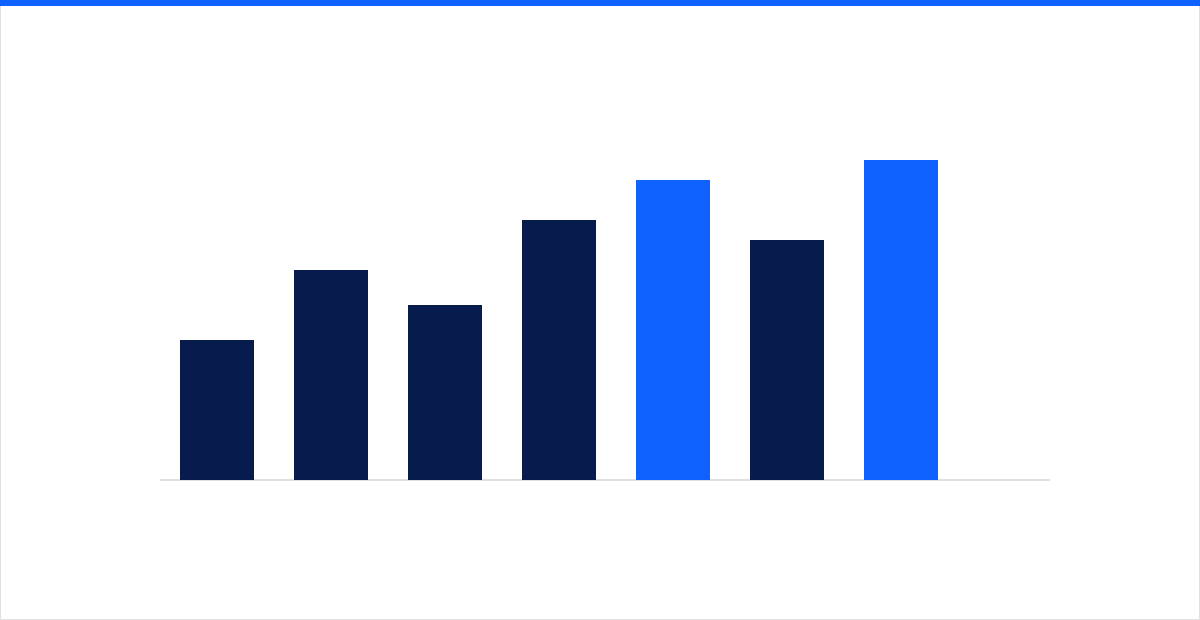 Figure: the reductions stack — but each technique trades a little accuracy for size and speed, so the real work is finding the point where the model is small enough and still good enough.
The discipline here is to measure the tradeoff, not assume it. Fix an accuracy floor the model must clear, then compress until you approach it — and validate on representative field data, not the clean training set. Building that optimize-and-validate loop is core to a mature machine learning and AI practice, and it is where edge projects are quietly won or lost.
The silicon that runs it
Optimization only pays off if the hardware can exploit it. Edge inference runs on a spectrum of processors, and matching the model to the right one is a real engineering decision.
- NPUs (neural processing units). Purpose-built for the matrix math of neural networks, NPUs deliver the most inference per watt and now ship inside phones, cameras, industrial gateways, and laptop system-on-chips. For a fixed, quantized model running continuously, they are usually the efficient choice.
- GPUs. More flexible and higher-throughput, well suited to larger models, batched workloads, or sites running several models at once. They draw more power and cost more, so they fit richer edge nodes rather than battery-powered sensors.
- Specialized accelerators. Edge tensor accelerators, FPGAs, and DSPs occupy niches where a specific model, latency target, or power envelope justifies tailored silicon.
- CPUs. For light models or low-frequency inference, an optimized model on a capable CPU is often good enough and avoids added hardware and integration cost.
Right-size to the actual workload. Provisioning a GPU for a model that a few-dollar NPU handles wastes capital across a large fleet; under-provisioning forces the very cloud round trips edge inference exists to avoid.
Operating models across a fleet
A single model on a single device is a demo. The real problem — and the reason edge AI programs succeed or rot — is operating many model versions across hundreds or thousands of devices that no one visits. This is MLOps meeting device management, and it needs to be planned from the start.
- Versioning and staged rollout. Treat each model as versioned, signed software. Push updates in waves with automatic rollback, never all at once — a bad model shipped fleet-wide is an outage, and a model that silently makes worse predictions is a slower, more dangerous one.
- Drift monitoring. A model that was accurate at launch decays as the world it sees changes — new lighting, new products, new fraud patterns. You cannot watch every device, so stream lightweight quality signals and confidence metrics back to a central console and alert when accuracy trends down. Fold model health into the same infrastructure monitoring that already watches the fleet so there is one place to look during an incident.
- A retraining loop. Route hard or misclassified cases back to the cloud, fold them into the training set, retrain and re-optimize, and redeploy. The edge generates the evidence; the cloud closes the loop.
- Security. Every device is a copy of your model and a possible entry point. Encrypt models at rest, verify signatures before loading, use strong device identity, and treat physically exposed nodes as untrusted. Model theft and adversarial input are edge-specific risks a data center never faces.
Computer-vision workloads — inspection, counting, safety monitoring — are the most common edge inference use case, and running them well leans on solid data analytics and computer vision foundations feeding the retraining loop.
The edge-plus-cloud split
The winning pattern is not edge versus cloud but a clean division of labor. Inference runs at the edge, where latency and privacy demand it. Training, optimization, aggregation, and fleet-wide model governance run in the cloud, where the compute and the complete dataset live, and freshly optimized models flow back out to the devices. Raw input is scored and filtered locally; only distilled signal and hard cases travel upstream.
When that split is clean, an uplink outage degrades a site gracefully instead of stopping it, and each layer does what the other cannot. When it is muddy — when a device cannot make a prediction without a cloud call — you have inherited the latency and fragility of a centralized design while paying for distributed hardware. Plan edge AI as part of your broader edge computing strategy, not as a model bolted on afterward.
Putting edge inference to work
Edge AI is not a replacement for cloud AI, and it is not right for every model. It is the correct answer when latency, bandwidth, privacy, or offline operation make centralized inference untenable — and it pays off only when the model is optimized to fit the hardware, the silicon is matched to the workload, and the whole fleet of models is versioned, monitored, and secured as rigorously as any production system.
intSignal designs and operates edge AI end to end: optimizing and validating models for constrained devices, selecting the right accelerators, and standing up the model ops that keep a distributed fleet accurate and secure over time. If you are weighing whether a workload belongs at the edge — or already have edge inference that has outgrown how you manage it — talk to our team for a straight assessment before it becomes a firefight.