Chargeback and Showback: Making Teams Own Their Cloud Spend

The shared bill is where accountability goes to die
A single cloud invoice arrives every month, it lands on one budget, and it is almost always larger than the month before. Finance cannot explain the increase because the number is a sum with no breakdown. Engineering cannot be held to it because no team sees its own share. Leadership asks why cloud spend is up 30 percent and gets a shrug. This is the default state of an untagged, undivided cloud account, and it is the single biggest reason cost-control programs stall.
The fix is not a new tool or a spending freeze. It is attribution — the discipline of splitting one bill into the pieces each team, product, and customer actually consumes, then putting those pieces in front of the people who create them. Chargeback and showback are the two models for doing that. Get them right and cost stops being a finance problem argued at quarter-end and becomes an engineering signal acted on daily. This is a core part of how we run public cloud estates for clients.
Tagging is the foundation you cannot skip
You cannot allocate what you cannot identify. Every chargeback or showback model rests on metadata — tags, labels, account structure, and folder hierarchy — that maps each dollar to an owner. Skip this and every later step collapses into guesswork.
A workable tagging strategy is small and mandatory, not sprawling and optional:
- Owner — the team or individual accountable for the resource.
- Environment — production, staging, development, so non-production waste is visible on its own.
- Application or service — the product the resource belongs to.
- Cost center or business unit — the budget the spend rolls up to.
Four to six tags cover most needs. Resist the urge to define forty; a tag schema nobody can remember is a tag schema nobody applies. Enforcement is what separates a policy from a wish:
- Block or flag untagged resources at creation using policy-as-code, so compliance is enforced when the resource is provisioned, not audited months later.
- Segment by account and project. Separate accounts, subscriptions, or projects per team or environment give you clean allocation boundaries even before tags, and they double as a security and blast-radius control.
- Measure tag coverage as a metric. Track the percentage of spend that is attributable and hold it above 90 percent. Below that threshold, every cost conversation stalls on "whose resource is this?"
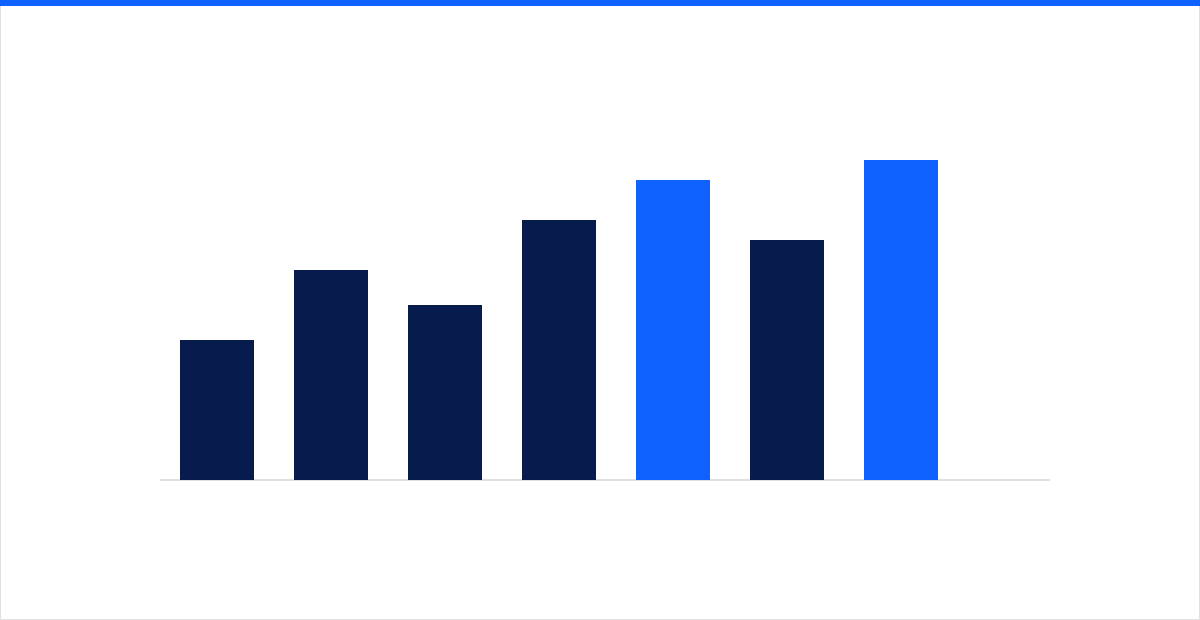 Figure: once spend is tagged to an owner, one opaque invoice becomes a ranked set of team-level bars you can actually manage.
Showback, chargeback, and shared-cost allocation
With attribution in place, you choose how far to push accountability. There are three models, and mature organizations use them in sequence and in combination.
- Showback reports each team its real cloud cost with no money changing hands. The budget stays central; the visibility is distributed. Showback changes behavior through transparency alone and is far faster to adopt because no team is defending its budget. Start here — it surfaces most of the waste within the first two reporting cycles.
- Chargeback goes further and moves the cost onto the consuming team's own budget. Now cloud spend competes with every other line item a manager owns, and the incentive to trim it is direct. Chargeback drives the strongest behavior change, but it demands allocation accurate enough to defend in a budget review, because teams will dispute a bill that lands on their P&L.
- Shared-cost allocation handles the spend that belongs to no single team — the platform, networking, logging, and security layers everyone uses. This is the part most programs get wrong, so it deserves its own treatment.
The practical path is showback first to build trust and clean up the data, then chargeback for the spend that is cleanly attributable, with a deliberate method for everything shared.
The hard part: shared services and discounts
Two categories break naive allocation, and how you split them determines whether teams trust the numbers or reject them.
Shared services — the Kubernetes control plane, the observability stack, shared databases, egress, security tooling — cannot be tagged to one owner because everyone uses them. Pick an allocation key and apply it consistently:
- Even split across teams is simple but punishes small consumers and rewards heavy ones — usually the wrong signal.
- Proportional to direct spend allocates shared cost in the same ratio as each team's own tagged usage. Easy to compute and reasonable as a default.
- Usage-based ties the split to a real driver — requests, ingested log volume, cluster CPU-hours. The most accurate and the most defensible, and the method worth investing in for large shared line items.
Discounts and commitments are the other trap. If one team buys a savings plan or reserved capacity and the discount lands only on that team's bill, everyone else keeps paying on-demand rates on paper and the incentive to commit collapses. The fix is a blended or amortized rate: pool commitment savings centrally and distribute the effective, post-discount rate across all consumers, so every team sees the same true unit cost and nobody is penalized for capacity someone else committed to. Likewise, amortize upfront reservation payments across the term rather than spiking one month's chargeback.
Whatever keys you choose, publish them. Allocation that teams cannot see or understand reads as arbitrary, and an allocation model nobody trusts gets appealed line by line until the program dies.
Unit economics: the number that actually matters
Total spend tells you what you paid. Unit cost tells you whether the business is healthy. The most valuable output of a mature allocation program is cost per unit of value — cost per customer, per tenant, per transaction, per thousand API calls, per order processed.
- A rising total bill is not automatically bad. If revenue and transaction volume rose faster, your cost per transaction fell and the business got more efficient. Without unit economics you cannot tell that story.
- Cost per customer exposes unprofitable accounts — the enterprise tenant whose usage costs more to serve than the contract brings in — that a total-spend view hides completely.
- Unit trends catch regressions early. A cost-per-transaction line that ticks up after a deploy is a code or architecture change worth investigating now, not a surprise at month-end.
Building these numbers means joining cloud cost data to business metrics — usage counts, customer identifiers, revenue — which is a data-engineering exercise as much as a finance one. This is where cost allocation converges with your broader data analytics practice: the same pipelines that power product analytics can carry the cost dimension that turns a bill into per-unit insight.
The cultural change is the real deliverable
The tagging, the allocation keys, and the dashboards are mechanics. The point of all of it is a shift in who owns cost.
- Make cost an engineering metric, not a finance report. Put spend and unit cost on the same dashboards teams already watch for latency and errors, and cost stops being someone else's problem quarterly.
- Give feedback where work happens. Budgets, anomaly alerts, and per-service views that flag a spike within days let a team fix a mistake while it is still cheap. The same anomaly found six weeks later is a write-off.
- Reward efficiency, not just cuts. Celebrate a falling cost per transaction, not just a smaller absolute bill, so teams are not punished for growth.
- Name an owner. Someone accountable for allocation accuracy and unit economics keeps the model honest as the estate changes.
Accountability lands only when people see their own number, trust how it was derived, and can act on it without asking permission. That is the entire game.
Turn one bill into real ownership
Chargeback and showback are not accounting overhead. They are the mechanism that connects the people who create cloud cost to the cost they create, and they are the difference between a bill that grows unexplained and one that reflects deliberate decisions. Start with tagging and showback, add fair shared-cost allocation and blended discount rates, and build toward the unit economics that tell you whether every dollar is working.
intSignal runs cost allocation as a managed practice across cloud infrastructure — tag enforcement, showback and chargeback models, shared-service and discount allocation, and the unit-economics reporting that ties spend to business value. Talk to our cloud team and we will start with an assessment of how attributable your bill is today and what it takes to make every team own its share.