IT Vendor Management: Fewer Surprises, Better Leverage

The vendor list nobody actually owns
Ask most IT leaders how many technology vendors they pay, and the honest answer is a shrug. Somewhere between the ticketing system, the endpoint agent, the email gateway, three overlapping backup tools, a pile of SaaS subscriptions bought on departmental cards, two connectivity providers, a hardware reseller, and the MSP that ties some of it together, a mid-size company routinely runs 40 to 80 active technology relationships. Each one has a contract, a renewal date, a support portal, a login, an invoice, and — in theory — an owner. In practice, most have drifted.
That sprawl is not free. It costs money directly, through redundant tools and auto-renewals nobody caught in time. It costs money indirectly, through the hours your team burns chasing the right vendor when something breaks and integrating tools that were never meant to work together. And it costs you leverage: when spend is scattered across dozens of small contracts that renew on different dates, you never accumulate the volume or the timing to negotiate from strength. Vendor management is the discipline that turns that scattered, unexamined sprawl into a managed portfolio you can actually steer.
Build the inventory before you do anything else
You cannot manage a vendor you have not written down, and almost no organization has a trustworthy list. The "approved vendor" spreadsheet in procurement typically captures a fraction of what is actually running — shadow SaaS, free-tier tools, and one-off purchases accumulate faster than any manual list tracks. So the first deliverable is a single, deduplicated vendor register. For each vendor, capture:
- What they provide and what it replaces or overlaps with — the functional role, so you can see redundancy.
- Contract term, renewal date, and notice window — most technology contracts auto-renew unless you give written notice inside a narrow window, often 30 to 90 days before expiration. This column is where leverage lives.
- Annual and monthly spend — the money, normalized so you can compare.
- The internal owner — a named person accountable for the relationship, not a department.
- Data and access held — whether the vendor touches regulated data, credentials, or production systems (this feeds the security section below).
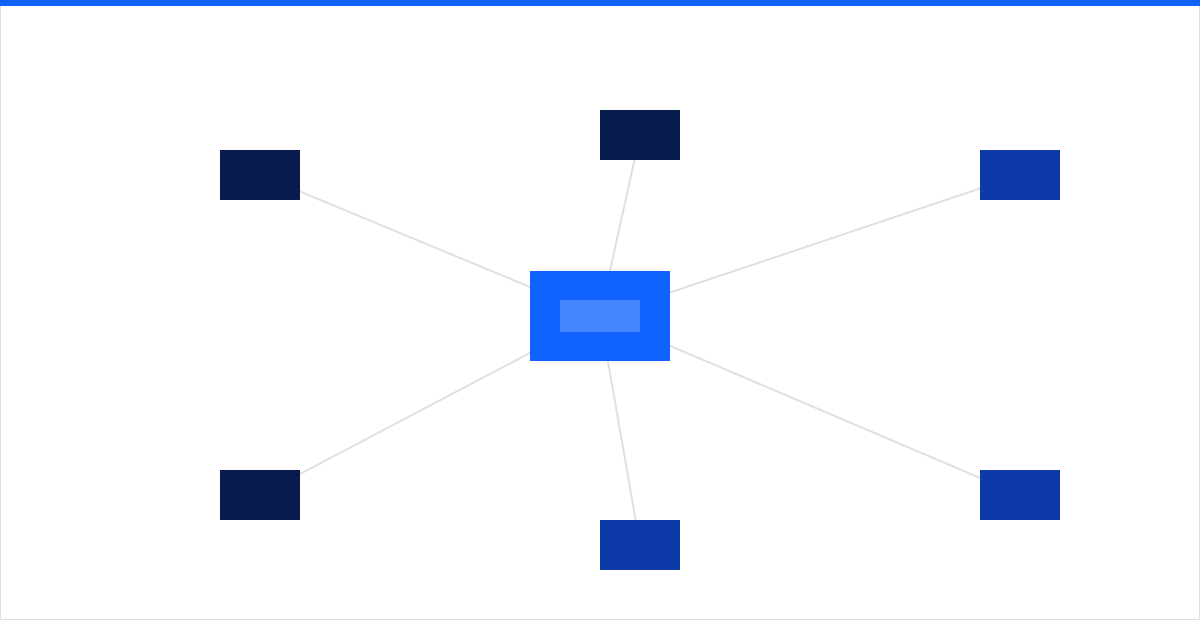 Figure: every vendor you add is another contract, renewal date, and support queue — a single accountable hub turns uncontrolled sprawl into managed spokes.
Build this once and the findings pay for the effort immediately: duplicate tools doing the same job, subscriptions still billing for a project that ended, seat counts far above headcount, and renewals that already slipped past their notice window and re-locked you for another year. The register is not a one-time artifact — it becomes the operating document the rest of the program runs on.
One point of accountability
The structural reason vendor spend and vendor problems leak is that responsibility is fragmented. Procurement signs the contract, finance pays the invoice, and the engineer who actually depends on the tool never sees either. When something breaks across two vendors — say, the network provider and the firewall vendor each blaming the other — nobody owns the seam, and your team becomes the unpaid integrator sitting in the middle of a finger-pointing call.
The fix is to assign a single point of accountability for the vendor portfolio: one function that owns the inventory, the renewal calendar, the escalation paths, and the commercial relationships end to end. For many organizations the most efficient home for that role is the same team that runs day-to-day operations. When complete IT support also owns the vendor stack, the people who use the tools and the people who manage the contracts are finally the same people — and vendor coordination during an outage becomes their problem to solve, not yours to referee.
Contract and SLA hygiene
A vendor relationship is only as good as what the contract actually obligates, and most IT contracts are signed under time pressure and never read again. Hygiene here means a few disciplined habits:
- Track every renewal against its notice window. A renewal calendar with alerts 90 and 60 days out converts silent auto-renewals from a trap into a scheduled decision point. Every renewal is a chance to renegotiate, right-size seats, or exit.
- Read the SLA, not the marketing. "99.9 percent uptime" means roughly 43 minutes of allowed downtime a month — but only if the SLA defines how uptime is measured, what counts as an exclusion, and what the remedy is. A credit worth 5 percent of one month's fee is not a remedy for an outage that costs you a day of revenue. Know what you are actually owed.
- Pin down support tiers and response times. The difference between a four-hour and a next-business-day response commitment is the difference between a contained incident and a crisis. Make sure the tier you pay for matches the criticality of the system.
- Settle exit terms before you need them. Data export formats, transition assistance, and destruction of your data at termination belong in the signed agreement, not in a panicked email during a switch.
Consolidation: fewer vendors, more leverage
Once the inventory is honest, consolidation opportunities become obvious. Three backup tools become one. Overlapping security point-products fold into a platform. A dozen small SaaS subscriptions get rationalized against what your core suite already includes. Consolidation is not about buying less capability — it is about buying it deliberately.
The payoff is threefold. Fewer contracts mean lower administrative overhead and fewer renewal traps. Concentrated spend means real negotiating leverage — a vendor treats a customer consolidating five products very differently from one buying a single seat. And fewer integration seams mean fewer of the cross-vendor failures that consume your team's time. The discipline is to consolidate without creating fragile single points of failure or lock-in you cannot escape; the goal is a smaller, stronger set of relationships, not dependence on one vendor for everything. Reviewing your stack against a coherent portfolio of services is often where the largest, most durable savings surface.
Security and data-processing requirements
Vendor management is also where a real share of your risk lives. Every vendor with access to your data or systems is an extension of your attack surface, and the contract is where you set the floor for how they protect it. For any vendor touching regulated or sensitive data, the essentials belong in a data processing addendum and the master agreement:
- A signed DPA defining permitted use, encryption, retention, and certified deletion of your data at termination.
- Breach notification on a defined clock — a hard deadline such as notification within 72 hours of discovery, not the word "promptly."
- Evidence over assertions — a current SOC 2 Type II report or equivalent attestation for critical vendors, reviewed for scope and exceptions rather than filed unread.
- Subprocessor disclosure, so a vendor cannot quietly push your data down a chain you never vetted.
A vendor register that already records what data each vendor holds is exactly the evidence auditors expect, which means the same work doubles as security compliance documentation across SOC 2, ISO 27001, HIPAA, and similar regimes.
Quarterly business reviews turn vendors into partners
Contracts and inventories keep vendors honest; quarterly business reviews (QBRs) make them useful. A QBR is a scheduled sit-down with each significant vendor to review the numbers that matter: SLA performance against commitment, open issues and how fast they closed, upcoming roadmap and end-of-life items, security posture changes, and spend against value delivered. It is where you catch a degrading relationship before renewal instead of after, and where you learn about a feature you are already paying for but not using.
QBRs also change the tenor of the relationship. A vendor that knows you review their performance on a cadence, with data, behaves differently from one that only hears from you when something is on fire. You become a customer worth keeping happy — which is precisely the leverage the whole program is built to earn.
From reactive to in control
IT vendor sprawl is not a problem you solve once; it is a condition you manage. An accurate inventory with renewals and owners, a single accountable point of contact, disciplined contract and SLA hygiene, deliberate consolidation, enforced security requirements, and regular QBRs turn a pile of unexamined subscriptions into a portfolio you steer — with fewer surprises and materially better leverage. The first pass almost always funds itself in caught renewals and retired duplicates.
If you are approving vendor invoices without a current inventory to check them against, that gap is the finding. Talk to our team and we will build you a reconciled vendor baseline — renewals, owners, and all — and take ownership of the stack so it stops owning you.