IT Budgeting: Planning Spend Without Surprises
The surprise line item
Most IT budget conversations go wrong in the same predictable way. The number that lands in the annual plan is last year's number plus a percentage, and then reality arrives: a storage array reaches end of support, a vendor lifts license prices at renewal, a ransomware scare forces an unplanned tooling purchase, or a new office needs connectivity in six weeks. None of these are true surprises. They are foreseeable events that never made it into the model because the budget was built as a single lump rather than assembled from the things that actually drive spend.
A defensible IT budget is built from the bottom up. You forecast asset refresh, software and subscription renewals, security investment, and the cost of growth as separate, traceable lines, then classify every dollar by whether it keeps the lights on or moves the business forward. Done this way, the budget stops being a negotiation over one number and becomes a plan you can defend line by line — and one that holds up when the year does not go exactly as drawn.
Capex is becoming opex — and the budget has to follow
The single biggest shift in IT budgeting over the past decade is the move from capital expenditure to operating expenditure. Buying a three-year block of servers, depreciating it, and refreshing on a fixed cycle is being replaced by cloud consumption, per-user SaaS, and managed services billed monthly. The finance implications are real: opex smooths large purchases into predictable recurring cost and frees capital, but it also removes the natural ceiling that a purchase order used to provide. Consumption-based spend grows quietly unless someone owns it.
Practically, this means an IT budget now has two very different halves. The capex half is lumpy and plannable — you know a refresh is coming and roughly what it costs. The opex half is continuous and elastic — it drifts with headcount, data volume, and usage. Treating both with the same flat-percentage increase is how organizations end up over-provisioned in one area and starved in another. The budget model has to forecast each on its own terms.
Run, grow, transform: the three-bucket view
Before you total anything, classify every line into one of three buckets. This framing, popularized by Gartner, is the fastest way to expose whether your spend matches your strategy:
- Run — keeping existing services alive: support, maintenance, renewals, refresh, connectivity, and the security controls that protect what you already operate. This is the majority of most IT budgets.
- Grow — extending current capabilities: more capacity, more users, new sites, incremental features that scale the business as it is.
- Transform — new capabilities that change how the business works: a cloud migration, an analytics platform, an automation initiative.
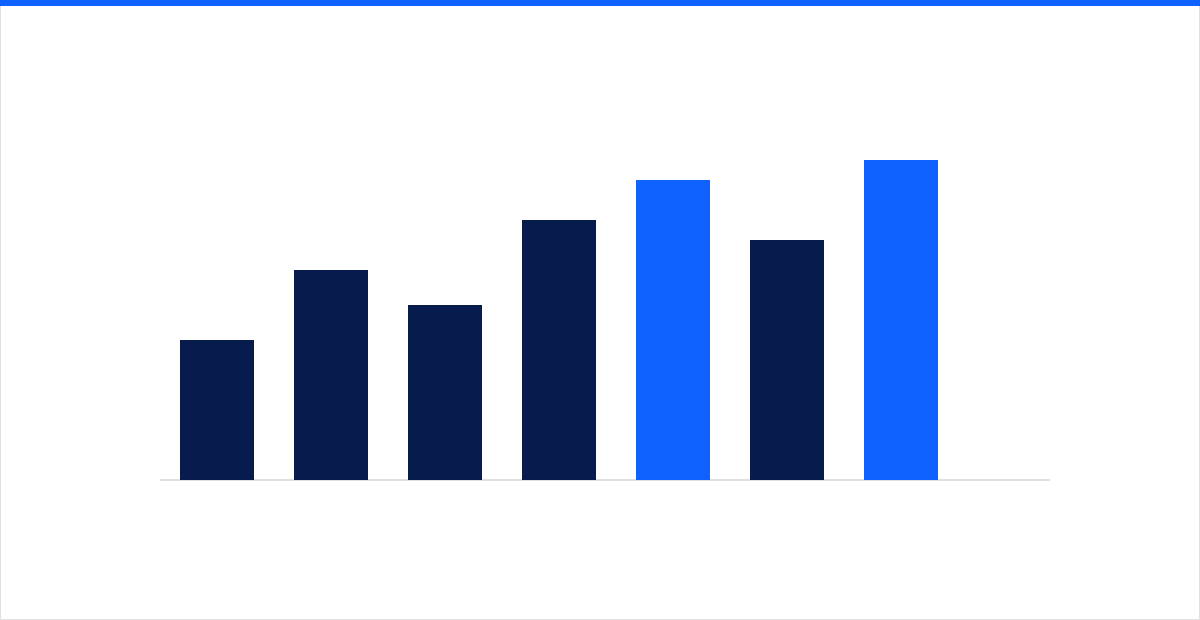 Figure: most IT budgets are dominated by "run" spend — the goal of good planning is to shrink it as a share so grow and transform have room without a bigger total.
The value is in the ratio, not the absolute numbers. Many mid-market IT organizations spend roughly two-thirds or more of their budget just running, which leaves little for anything that moves the business. If leadership wants transformation but the budget is 80 percent run, the plan and the money are not aligned, and no amount of optimism closes that gap. Bringing run costs down as a share — through automation, consolidation, and managed delivery — is what funds grow and transform without inflating the total.
Building the budget from the bottom up
Once the framing is set, assemble the number from its real drivers. Four components account for most of a well-built IT budget.
Asset lifecycle and refresh
Every device and system has a service life, and running hardware until it fails is the most expensive refresh policy there is: it maximizes downtime, warranty gaps, and emergency purchases at list price. The alternative is a lifecycle model. With purchase dates, warranty status, and end-of-support dates in one place, you can forecast next year's replacements, spread them evenly rather than in panic buys, and stage operating-system migrations before support windows close. A typical cadence is a three-to-five-year refresh for endpoints and a four-to-six-year cycle for servers and network gear, though the right number depends on workload and risk. Continuous server and infrastructure management keeps that inventory current so the refresh line is a forecast, not a guess.
Licensing and subscriptions
Software is where budgets quietly leak. Renewals rarely stay flat — vendors raise prices, bundle changes force tier upgrades, and per-user tools scale with headcount. Budget every major renewal at its expected new price, not last year's, and reclaim what you are not using. Common waste includes seats for departed employees, premium tiers bought for a project that ended, and overlapping tools that do the same job for different teams. A quarterly software rationalization — match every paid entitlement to a named user or running asset, flag anything unused for 60 to 90 days, then reclaim or cancel — turns renewal season from a fire drill into a report you can run on demand.
Security
Security is not a discretionary add-on to be funded only in good years; it is a run cost of operating at all, and increasingly a condition of doing business. Cyber-insurance underwriting and customer security reviews now require specific controls, so under-funding this line does not save money — it defers a larger, less controlled expense. Budget for endpoint protection, identity, monitoring, vulnerability management, and awareness training as recurring lines. Many organizations get better coverage per dollar by consuming these as a service rather than staffing each in-house; that is the premise behind security as a service, where the tooling and the expertise to run it come as one predictable subscription.
Growth and change
Finally, budget for the business you will be, not the one you are. If headcount is projected to rise 15 percent, licensing, endpoints, and support scale with it. A planned acquisition, a new site, or a product launch each carries an IT tail. The mistake is treating growth as a mid-year surprise when it was on the corporate plan all along. Ask the business what is coming and price it in before the year starts.
The true cost of downtime and deferred maintenance
The hardest line to defend is the one that prevents problems, because its return shows up as an absence. But deferred maintenance is not free — it is a loan against future uptime at a high interest rate. Skipping a refresh, delaying a patch cycle, or running past end of support converts a planned, discounted expense into an unplanned, premium-priced emergency, often with downtime attached.
Downtime is where the real number lives. When you weigh a resilience investment, put it against a defensible estimate of what an outage costs per hour:
- Direct — lost revenue and transactions during the outage window.
- Productivity — idle staff who cannot work while systems are down.
- Recovery — overtime, emergency vendor engagement, and expedited hardware.
- Reputational — the customers and contracts that do not come back, and the regulatory or breach exposure. IBM's Cost of a Data Breach research has put the global average breach in the millions of dollars, a reminder that the tail risk dwarfs the maintenance line.
Multiply a conservative hourly figure by a realistic recovery time and the case for the maintenance line usually makes itself. This is the same math that justifies proactive, complete IT support: steady, budgeted prevention is nearly always cheaper than the emergency it displaces.
Benchmarking without cargo-culting
Benchmarks are useful for sanity-checking, not for setting targets. IT spend as a percentage of revenue varies widely by industry — a software firm and a manufacturer have completely different profiles — so any headline "companies spend X percent on IT" is close to meaningless without your sector and model. Use benchmarks two ways: compare your run-grow-transform ratio against peers to see whether you are over-weighted on keeping the lights on, and track your own spend per user or per workload over time to spot drift early. The most valuable comparison is against your own trend, not an average of companies unlike yours.
Plan in multi-year cycles
A single annual budget hides the lumpiness that causes surprises. Refresh cycles, license terms, and transformation projects all span multiple years, so plan on a rolling three-year horizon even if only year one is approved. Lay refresh waves across the years so no single year absorbs every replacement at once, and give leadership visibility into the large items coming down the line. Your hardware, software, and service inventory is the raw material for this — see how a reconciled asset and product view feeds directly into the forecast.
Budgeting without surprises is not about predicting the future perfectly; it is about building a model from the drivers that are already knowable and leaving room for the ones that are not. If your IT budget is still last year's number plus a percentage, we can help you rebuild it from lifecycle, licensing, security, and growth into a plan you can defend. Talk to our team and we will turn your spend into a forecast instead of a surprise.